
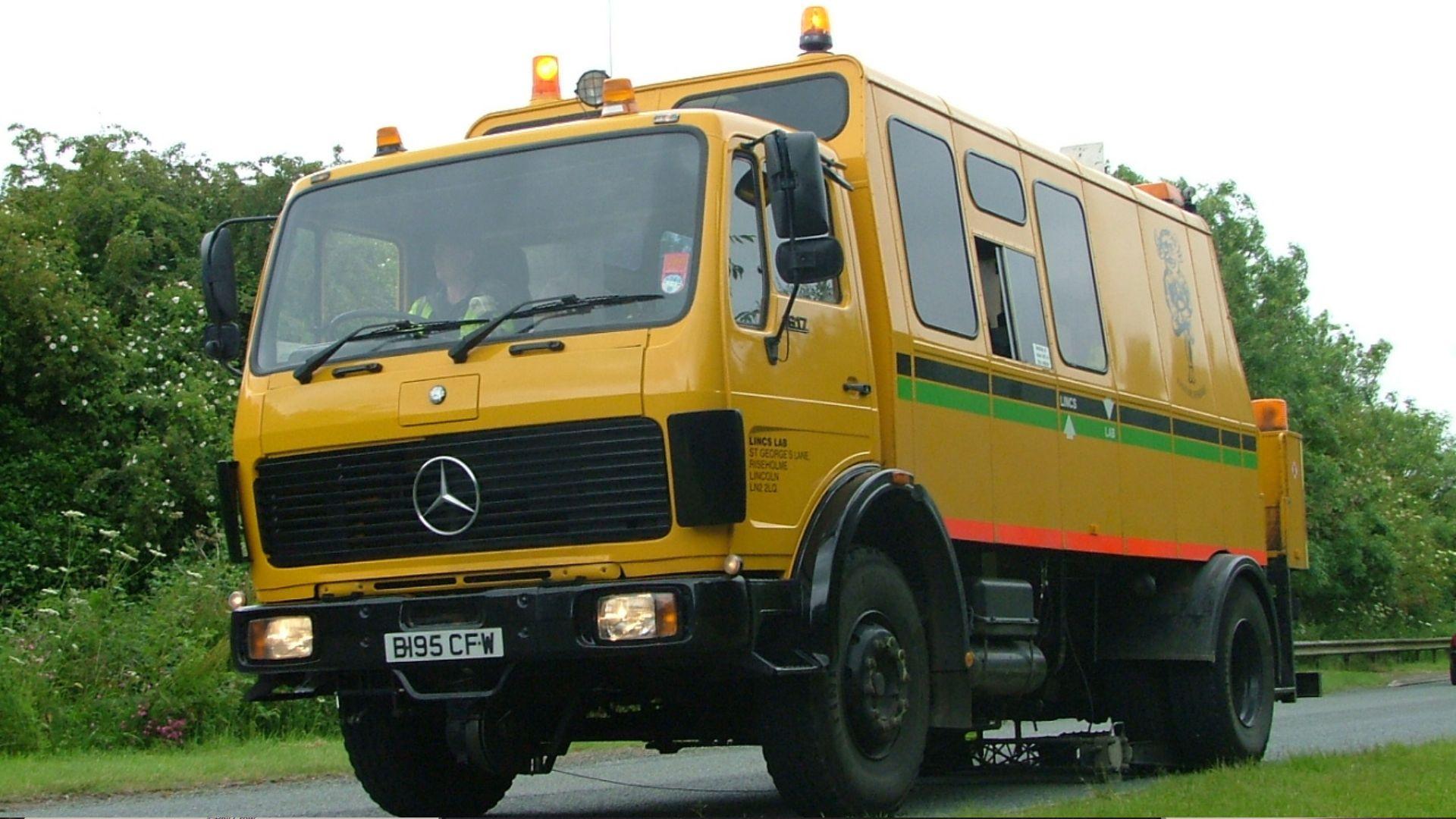
Specialist equipment is helping Lincolnshire County Council look beneath the road surface and make more informed decisions about where and how to invest in major highway repairs.
The council's Deflectograph – a specialist HGV operated by Lincs Laboratory – is currently surveying roads across Lincolnshire as part of the data collection programme that will help shape the council's 2027/28 Strategic Road Scheme (SRS) programme.
While many road inspections focus on what can be seen at the surface, the Deflectograph looks beneath it, measuring how the road's underlying structure responds to the weight of the vehicle. This provides engineers with a clearer picture of how much useful life remains in the road and whether a location is likely to need surface repairs or more substantial, deeper treatment.
Importantly, what a road looks like on the surface does not always tell the full story. A road may appear in reasonable condition but have underlying structural weaknesses that mean more substantial treatment is required. Equally, visible surface deterioration does not necessarily mean the whole road needs to be reconstructed.
By combining information about the road's underlying condition with other evidence, engineers can determine the most appropriate treatment and avoid either doing too little or spending more than is necessary.
Cllr David East, executive member for highways and transport at Lincolnshire County Council, said:
"Maintaining Lincolnshire's roads is about much more than simply looking for potholes and deciding where to resurface. We need to understand what is happening beneath the surface too, particularly on some of our busiest and most important routes.
"Sometimes residents understandably ask why we are carrying out work on a road that appears to be in reasonable condition, while on other occasions a road that looks badly damaged may receive a treatment that doesn't involve completely rebuilding it. The reason is that our engineers have information about what is happening beneath the surface that isn't visible to the naked eye.
"The Deflectograph gives our engineers another valuable piece of evidence when deciding where investment is needed and, importantly, what type of treatment is appropriate. This means we can target our funding where it will have the greatest long-term benefit and be confident that the work we carry out is addressing the condition of the road.
"The information gathered will form part of the evidence used to develop our 2027/28 Strategic Road Scheme programme, helping us make informed decisions about where major maintenance is needed and how those schemes should be designed."
Only around 10 to 12 Deflectographs are thought to be operating in the UK, across three survey contractors, although not all are in operation at the same time.
The Deflectograph is operated by two technicians – a suitably licensed HGV driver and an operator who manages the measurement equipment. Lincs Laboratory currently has three technicians qualified to drive the vehicle, alongside an additional back-up operator.
Measuring what lies beneath the road
As the Deflectograph travels along a road, two beams positioned between the vehicle's rear tyres measure how much the road surface moves under the weight of the HGV. The movement is incredibly small – measured in hundredths of a millimetre – with readings taken every three to four metres in both wheelpaths.
Engineers combine these measurements with information including the temperature of the road, the thickness of its construction and current and historical traffic levels. Mathematical modelling is then used to estimate the remaining useful life of the road's underlying structure and identify where deeper repairs are likely to be required.
The information is used alongside other sources of evidence, including road cores, visual inspections and defects reported by the public. Together, this helps engineers determine whether problems are confined to the upper layers of the road or whether more substantial work is needed underneath.
Helping make the most of taxpayers' money
The information gathered by the Deflectograph is used both to select and prioritise potential schemes and to help design the work once a scheme has been chosen.
This can prevent the council from spending more than necessary on a road that does not require full reconstruction, while also avoiding the opposite situation – carrying out a superficial repair where deeper problems could cause the road to deteriorate again.
Cllr East added: "Every pound we spend on our highways needs to deliver the best possible value for residents. The Deflectograph helps us do that by giving our engineers a much better understanding of the condition of the road beneath the surface.
"That means we can make informed choices about whether a road needs surface treatment, deeper repairs or a combination of different approaches. When we do carry out major maintenance, we can be confident that we’re addressing the underlying problem and delivering a durable repair that ensures the road will last many years into the future.
"This is a good example of how data, scientific analysis and engineering expertise help us manage one of the country's largest road networks and make sure investment is targeted where it is needed most."
Building the 2027/28 programme
The Deflectograph data is one of several sources of information that will be used to develop the council's 2027/28 Strategic Road Surfacing programme.
The survey work is carried out across the county's Strategic Road Network, which covers just over 900 miles. This includes Lincolnshire's A-road network, alongside a small number of heavily trafficked B and C roads.
Sam Edwards, head of highways infrastructure for Lincolnshire County Council, said: "Because Lincolnshire has such a large road network, we survey our busiest routes through a rolling five-year programme, helping us manage our resources and make sure we have up-to-date information to inform our maintenance decisions.
"The Deflectograph operates during two survey seasons, roughly from mid-March to June and mid-September to November, as road temperatures can affect the accuracy of its measurements. It travels at around walking pace while carrying out surveys, so rolling stop-go traffic management or road closures are sometimes needed to allow the work to take place safely.
"Across the year, Lincs Laboratory aims to survey just under 200 miles, giving our engineers valuable information to help us understand the condition of the network and plan future investment."
From advanced testing equipment to specialist survey vehicles, Lincs Laboratory combines engineering expertise with modern technology to deliver reliable results. This includes equipment capable of measuring the strength of asphalt under controlled conditions, as well as machinery that assesses how road surfaces respond under load to identify underlying structural issues before they become more serious.
The Lincs Laboratory team is made up of 37 permanent staff and a pool of relief surveyors who work both on-site and in the laboratory to test materials, assess road conditions and gather vital data used to inform future investment decisions and maintenance priorities across the county’s highway network.
The laboratory is accredited to nationally recognised standards for quality and safety, ensuring all testing and processes meet rigorous industry requirements.
For more information about Lincs Lab, visit www.lincolnshire.gov.uk/lincslab.