
Introduction - better belonging
Lincolnshire County Council and the local area SEND partnership is firmly committed to supporting children and young people with special educational needs and disabilities (SEND) and those requiring alternative provision (AP).
Building on the foundations of significant sufficiency investment over the last 6 years, the better belonging SEND sufficiency strategy sets out a bold and inclusive vision for the future of inclusive education in Lincolnshire.
At its heart is a simple but powerful principle:
- belonging: every child should feel respected, included, and optimistic about their future—supported to learn and grow within their local community
This strategy recognises that support must be flexible, responsive, and rooted in the places children live and learn.
By reducing reliance on long-distance placements and costly home to school transport, it aims to strengthen community connections, improve outcomes for children and families, and ensure the SEND system remains financially sustainable.
Partners in education, health and social care are committed to working together to provide an integrated school system where children and young people get the right health, care and education, in the right place, at the right time and have a positive transition to adulthood and independence.
There is an established local area partnership expectation and agreement for inclusion to be embedded throughout all schools and a commitment to fully engage with and implement available provision and support to meet children and young people’s needs as early as possible.
This strategy will be reviewed annually by the SEND and AP strategic partnership board to take account of updated forecasts and changing needs. It will be responsive to changes in need and demand, and informed by the detailed analysis of live data.
How our strategy has been developed
This strategy has been developed collaboratively with representatives from education, health, and social care through the SEND and AP strategic partnership board.
It is grounded in the core values of “better belonging,” which reinforce Lincolnshire’s vision of an inclusive education system. In addition to professional input, the strategy reflects feedback from parents and young people, gathered through lived experience surveys, LPCF’s week of SEND and bi-annual survey, Lincolnshire Young Voices (the local area’s young person’s participation group) and previous participation and engagement events.
A multi-disciplinary task and finish group, led by Lincolnshire’s assistant director for children’s education, meets regularly to map our current provision, rationalise data, develop forecasts, identify gaps in provision, and agree plans for potential resource bases, special schools, and satellite provision. We have looked at our current capacity, spoken to individual schools, and commissioned projections and forecasts of future need.
All current data intelligence and forecasting formulas informing this strategy have been validated by an independent organisation with particular expertise in this sector. This external provider has supported the development of a SEND data dashboard, which uses data to provide up to date, live trajectories which inform sufficiency planning.
Moving forward, the intelligence will inform and direct this flexible and dynamic strategy to ensure we continue to deliver against demand, at the right time in the right place, as close to home as possible.
Our vision and ambition for better belonging
At the core of our inclusion strategy is the ambition of better belonging. Belonging enables us to feel confident, being personally respected, included, and supported by others, enabling us to be empowered across our full range of skills, abilities and potential.
Our sense of belonging is more than just an acquaintance between people or a group, it stems from being seen, accepted, and feeling connected.
From being supported by others and doing the same for them, having our presence and contributions valued, from everyone, including friends, family, agencies, educational settings, and the community.
Belonging is more than just inclusion; it is personal and different for each child or young person and should foster a sense of psychological safety, authenticity, and mutual respect.
Children and young people should feel safe to express themselves without fear of judgment or retaliation. This is key in teams and organisations where innovation and collaboration thrive.
- children and young people should be encouraged to be their true selves, rather than conforming to a dominant culture or hiding aspects of their identity
- belonging improves when systems are fair—when opportunities, recognition, and resources are distributed equitably
- strong relationships and a sense of shared purpose help people feel they truly belong, not just that they’re present
- people feel they have a say in decisions that affect them and that their perspectives are genuinely valued
Lincolnshire is committed to continuous improvement to deliver better belonging; the best experiences and outcomes for children and young people with SEND so that they thrive.
Lincolnshire’s inclusion strategy sets out our collective responsibility to ensure that children and young people with SEND are supported to achieve the best possible outcomes in school and in life, through the following priorities:
- making support work for families and communities
- inclusive school environments
- prepared for adulthood
- championing positive experiences
- improving the range and quality of provision
Current demand
Lincolnshire County Council has a statutory duty under section 14 of the Education Act (1996) to ensure that there are sufficient school places available to meet the needs of all children living in our county. This includes securing provision for children and young people with SEND.
Requirements for educational sufficiency are also placed on local authorities by the Children and Families Act (2014) and the SEND Code of Practice (2015). The Code of Practice provides that “all CYP are entitled to an appropriate education, one that is appropriate to their needs, promotes high standards, and the fulfilment of potential.”
Lincolnshire County Council has a statutory duty to arrange suitable education for children who cannot attend mainstream provision due to various reasons such as exclusion, illness or other circumstances. This duty is outlined in section 19 of the Education Act 1996, which requires local authorities to ensure that children of compulsory school age receive full-time education.
It is therefore imperative that the SEND and AP partnership has a robust and deliverable strategy which is responsive to changes in need and demand, and which meets the sufficiency needs of the local community.
The demand for SEND and AP places has grown significantly over the last 10 years. Nationally, there are currently over 1.7 million pupils with SEND in England which equates to almost 20% of the school population. This is broken up into:
- 5.3% of pupils having an education, health and care plans (EHCP) – approximately 482,600 pupils
- 14.2% of pupils at SEN support level – approximately 1,284,300 pupils
The numbers are significantly higher than 2024, particularly at EHCP level, where there was an 11.1% increase for children and young people with EHCPs, doubling the number since 2016. 56.2% of pupils with EHCPs are being educated in mainstream settings, a slight increase from last year.
Since 2020, Lincolnshire has seen a 77% increase in the number of maintained (EHCPs), rising from 5,119 to 9,081 in August 2025. This growth reflects a mix of local needs, improved practice in early identification of need, and wider pressures on the SEND system.
In 2023-24 Lincolnshire saw a further increase in the number of exclusions that Lincolnshire schools were issuing; 8.4% increase following a 89.9% increase in 2022-23. In 2024-25 there was a 7% decrease in the issuing of permanent exclusions, which is very positive and a strong indication of the steps being taken by settings. However, Lincolnshire continued to issue high numbers of exclusions, indicating that our schools are continuing to resort to issuing exclusions as a way of managing behaviour.
Ensuring sufficient places
There is a clear need to continue to create tailored solutions to meet the growing demand through expansion of existing facilities as well as the development of new types of provision.
Ensuring that there are sufficient places of the right type, in the right place, and at the right time, for children and young people with SEND and those requiring alternative provision is fundamental to being able to carry out our commitments within Lincolnshire’s inclusion strategy.
By approaching our SEND and AP sufficiency requirements through a tiered approach, we aim to make significant improvements across the education sector, with betterment in mainstream, specialist and alternative provision.
Improvements will be multi-faceted, targeting teaching and learning, increased sufficiency in the education estate and implementation of a range of provisions which will meet the wide range of complexity and need types.
This tiered approach provides a continuum of educational provision for children and young people who require an enhanced educational offer due to their specific individual needs.
A tiered approach
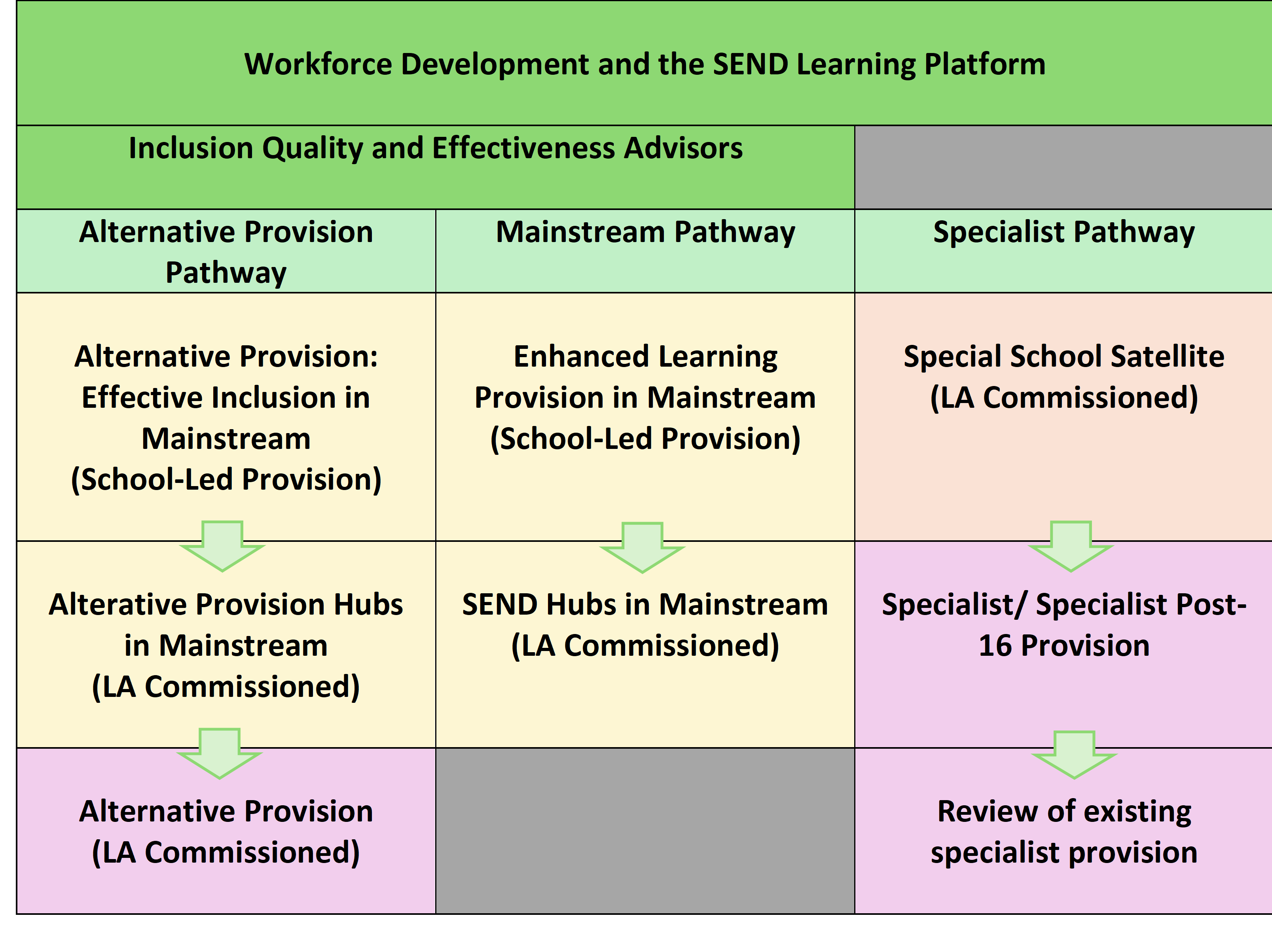
To meet the diverse needs of children and young people, the strategy introduces a tiered model of support, ensuring the right help is available at the right time, in the right place.
Ordinary provision offer
At the core of this strategy is a strong investment in people. Lincolnshire is expanding its SEND workforce development programme, helping schools build the confidence and capacity to meet increasingly complex needs. This includes:
- expansion of the sector-led training platform for professionals, including an additional 16 training modules, with subject area identified from user feedback
- actively encouraging all schools to access the learning platform as part of the core continued professional development offer. Evidence which suggests a correlation between accessing the SEND learning platform and improvements in school inclusion, with Ofsted recognising this in recent school inspections
- targeted continued professional development and peer-led learning
- continuation of the bespoke training package supporting the roll-out of mainstream SEND and AP hubs
- a focus on early intervention of need to reduce the long-term need for specialist placements
By equipping staff with the tools and knowledge they need, inclusive practice becomes embedded across all settings, creating a culture where every child can be supported effectively and families can be confident that there needs can be met by skilled and knowledgeable workforce in a mainstream setting.
Inclusion quality and effectiveness advisors
Lincolnshire’s inclusion quality and effectiveness team offers support to mainstream schools to effectively meet the additional needs of their pupils and increase schools’ confidence in their ability to do this.
The team provides critical professional partnership working with mainstream schools, providing challenge and support to senior leaders, high quality provision, ambitious outcomes, to strengthen the quality and effectiveness of early intervention and the graduated approach.
The quality and effectiveness team support mainstream schools with the implementation of the tiered initiatives identified in the strategy, to ensure these provisions remain consistently effective in their educational offer.
They also play a key role in the quality and effectiveness of the SEND and AP hub provision, supporting schools to provide high-quality, effective teaching and learning to hub pupils, including the development and review of a differentiated curriculum, early identification of additional needs and planning pupil-centered interventions.
Mainstream pathway
The Council believes that mainstream schools can offer the majority of pupils with SEND the opportunity for real inclusion but that they require access to enhanced support and resources to be able to continue meeting need throughout a student's education.
Following the implementation of our first wave of SEND hubs across the 2025-26 academic year, we will further expand our offer to mainstream schools by developing the following:
Enhanced learning provision (ELP)
Mainstream schools will be supported to implement enhanced learning provisions. ELP’s are school-led initiatives designed to support pupils who are working below age-related expectations or facing additional vulnerabilities, particularly during key transitions such as early years to primary or primary to secondary.
Many inclusive schools already successfully provide this type of informal intervention to children and young people with SEND or behavioural needs throughout the school day. The council will support the implementation of this type of provision through the SEND workforce development offer and with interventions from our inclusion quality and effectiveness advisors.
- to access an ELP, pupils do not need an EHC plan
- teaching is delivered in small groups by trained school staff, but also with access to the wider curriculum
- ELPs are tailored to the needs of each school’s community, promoting early intervention and reducing escalation to specialist settings
ELPs are a key part of the strategy’s focus on and very much supported through the workforce development programme, ensuring schools are equipped to support their pupils as they progress.
Mainstream SEND hubs
Building on our work programme of launching SEND hubs in Lincolnshire, this strategy further prioritises mainstream inclusion by creating more mainstream SEND hubs. This type of provision provides an enhanced educational experience for children and young people with SEND, enabling them to be educated and have their needs met in a mainstream school, in bespoke environments, taught by knowledgeable and skilled staff.
We will review the mainstream school estate with regards existing sufficiency and identify any surplus accommodation which could be remodelled and developed to house a SEND hub, making best use of existing capital assets. Utilising surplus accommodation maximises available space within our education estate (including academies where the council is the landlord) which are currently under-utilised. SEND hubs will also seek to support under-capacity schools to ensure future sustainability by making best use of available spaces.
Once schools with potential capacity have been identified, we will work in partnership with these settings to explore the viability of developing a SEND hub on these sites. We will give due regard in the identification process to localised demand and also prioritise equity of access, in terms of location and educational phase in order to ensure sufficient secondary provision to support the child’s educational journey.
A mainstream SEND hub is a small, adapted area within a mainstream school or academy that provides tailored support for children with SEND. Mainstream SEND hubs are highly structured settings within mainstream schools. Commissioned by the council for pupils with an EHC plan, it provides a structured and supportive environment for pupils whose needs cannot be fully met in a standard mainstream classroom.
The ethos of the hub is belonging - children are supported to access mainstream activities and learning opportunities in the wider school environment, where appropriate, whilst being taught a differentiated curriculum in a small class for the majority of the school day.
Each SEND hub classroom is set up to support a maximum of 13 children at any one time, with a maximum of 2 hub classrooms per school. In each classroom, ten places are formally commissioned by the council, while the remaining 2 to 3 are flexible, or “transient,” places that the host school can use to support their own pupils. These transient places are intended to provide short-term support throughout the school day and are allocated by the host school.
Mainstream SEND hubs are an integral part of the mainstream school, physically and culturally, with inclusivity and belonging at their core. The hub belongs to the school, is managed by the school and is staffed by the school – the council’s responsibility is to provide funding, support and to quality assure the provision.
For the ten council commissioned places, admission to a SEND hub is a structured and collaborative process designed to ensure that placements are appropriate, sustainable, and in the best interests of the child. The process is governed by the principles of inclusion, transparency, and partnership between the council, the host school, parents, carers, and relevant professionals.
SEND and AP hub pupil placement funding is determined through a theoretical model using key cost drivers of delivery that are costed to determine overall hub funding
Specialist pathway
The Children and Families Act 2014 secures the general presumption in law of mainstream education in relation to decisions about where children and young people with SEND should be educated.
Lincolnshire fully supports the presumption of mainstream education for the majority of children and young people.
We recognise that, where necessary, a very small number of children and young people with the most complex needs should be educated within settings which can provide the most specialist teaching and learning opportunities.
Experienced specialist teachers educating pupils in specialist environments, specifically designed to support those with the most complex needs can provide children and young people with the foundations to achieve the best possible outcomes.
However, this type of provision should be reserved for those with the most complex needs in order to retain its integrity and effectiveness.
Expanding special school capacity
To meet growing demand for specialist provision, the council is exploring repurposing vacant buildings to expand the special school estate. This approach not only creates more capacity within the special school portfolio but also supports the preparation for adulthood (PfA) agenda, helping young people move gradually and confidently towards independence and future opportunities. These remodelled spaces are intended to create post-16 provision on separate sites, freeing up classroom space in the existing special school for pre-16 pupils.
As the new premises will be designed specifically for the post-16 specialist curriculum, young people will have access to high-quality facilities which meets their specific learning needs.
Our ambition is to ensure that young people who require specialist post-16 provision will have access to a dedicated facility in their locality, through exploring the viability of establishing tailored post-16 specialist provision.
In addition, we will continue to work with our existing special schools to ensure that all spaces are being effectively utilised and that they remain at optimum capacity. Opportunities to develop additional teaching spaces in the existing estate will continue to be explored as part of the sufficiency programme.
Capital developments in these sites, should they be deemed feasible, would be funded from the Department for Education high needs capital allocation.
Special school satellite provision
This strategy will explore the viability of special school satellite provision, linked to existing special schools, in order to promote closer ties and collaboration across the education sector and enable special school pupils to access mainstream opportunities.
Special school satellites are bespoke provisions established within a mainstream setting, where special school pupils are educated and supported by staff from a special school.
They operate as a satellite of the local special school, providing special school pupils with the opportunity to access elements of the mainstream curriculum and school day, with the supportive and nurturing ethos of their special school.
Satellites offer special schools the opportunity to develop close links with their local mainstream provision and actively encourage a collaborative approach to teaching those with SEND.
All students allocated a place in the satellite would have an EHC plan. All pupils would remain on the special school roll and would regularly access the special school for shared events. Pupils would have a highly integrated and personalised timetable with opportunities for supported inclusion in mainstream lessons and social activities within the mainstream school, therefore providing flexible opportunities for social inclusion. This may include but is not exclusive to the school dining area, play spaces, assemblies, tutor programmes, community activities.
The ultimate aim would be to broaden pupil's educational experience and enable them to access wider curriculum opportunities.
The provision aims to develop each young person’s functional literacy and numeracy skills, their personal and social independence skills, communication and organisational skills and their emotional development as adolescents. Satellites could also support pupils who are considering a return to mainstream school by introducing elements of this setting, through a gradual and considered approach.
This approach would support workforce development, with special school staff sharing skills and knowledge with their mainstream colleague, enhancing the mainstream skill set.
Satellites would:
- extend geographical reach
- offer flexible, localised provision
- ease pressure on centralised sites while maintaining continuity of care
Satellite sites will allow more children to access specialist support closer to home, improving family engagement and reducing travel burdens.
Alternative provision pathway
The Council recognises the need for greater capacity in alternative provision to meet the growing demand and our statutory duty around 6-day provision.
However, our priority must be to enhance the support available to our mainstream partners in meeting the needs of the most vulnerable children and young people without resorting to exclusions, ensuring that exclusion is seen as an undesirable outcome rather than a justifiable sanction so that every child or young people feels part of their local school community.
That is why our first strategic vision for alternative provision is a preventive model, which we believe will support mainstream schools to avoid permanent exclusion wherever possible and strengthen their ability to meet the behavioural needs of their pupils.
Alternative provision: effective inclusion in mainstream
It is our intention to explore further opportunities to reduce the number of permanent exclusions, by providing capital support for mainstream schools, to provide enhanced intervention spaces within the existing school footprint.
These individually designed spaces would provide the opportunity for regulation and interventions throughout the school day, for those pupils whose behaviour places them at risk of exclusion.
They could be achieved by the remodelling of surplus accommodation, identified through analysis in all schools across the county. This development will provide physical spaces for mainstream schools to support their pupils back into their learning, with guidance and support on the effective running of the spaces from our quality and effectiveness team. The outcome from this early intervention will be to reduce exclusions across the county, empowering schools to meet need without resorting to sanctions which place pupils outside of their local communities.
Mainstream AP hubs
We will continue to explore the feasibility of mainstream AP hubs, in partnership with viable and committed schools and academies, to increase our AP sufficiency. AP hubs will form part of our inclusive mainstream offer, providing an enhanced level of support and provision for pupils who have been permanently excluded from their current setting. They will be run by mainstream schools as an integral part of their school, providing a base and support alongside opportunity to access aspects of the school day within the mainstream environment.
AP hubs will be provided by mainstream staff with a higher level of training and specialist expertise in meeting the needs of pupils that have been permanently excluded. A training offer for the setting up and ongoing professional development of staff would be provided by the council and the Lincolnshire SEND alliance. A bespoke package of training has been developed with sector experts, designed to grow and enhance staff skills and knowledge base.
AP hubs will primarily focus on key stage 3 and 4 based within secondary settings as this is where our AP demand is currently situated, though the need for primary provision will remain under review.
Each provision will be a maximum of two classrooms for a maximum of eight council commissioned places per class, with 2-3 additional transient places for the host school to access per classroom. This will provide the host school with the opportunity to utilise the provision to support their whole school inclusion approach and strengthen their ability to meet children and young people’s needs within their school.
Each pupil place will come with an agreed allocation of funding that will enable each class to be staffed by one teacher and two learning support assistants.
How we will fund the strategy
At present, all local authorities annually receive capital funding from central government to address sufficiency needs for children and young people with SEND.
The Education Act 1996 sets out a statutory duty on local authorities to secure sufficient school places, which they must do with regard to securing special educational provision for pupils with SEND as well as those requiring AP.
The Children and Families Act 2014 also places important statutory responsibilities on local authorities for supporting children and young people with SEND, including keeping the sufficiency of educational provision for them under review.
This funding is not ring-fenced and can be used in a variety of ways to create additional SEND and AP capacity across both mainstream and special schools.
The council proposes to use this funding to implement the better belonging sufficiency strategy, as is its intended purpose.
The investment of this annual allocation builds on the strong capital investment into the specialist sector which has enabled us to increase capacity in this sector by 527 places over the last 5 years.
It is our intention to ensure the high needs capital allocation is targeted appropriately to ensure sufficiency is being created in the right areas and in the right type of provision.
Any decisions we make regarding SEND and AP sufficiency and place planning are based on robust and up to date data, regularly reviewed by the SEND and AP local area partnership.
By utilising high needs capital allocation to provide additional capacity it is anticipated that this will mitigate the unsustainable costs to the SEND budget
High needs capital allocation
| Year | High needs capital allocation | Projects |
|---|---|---|
| 2024-25 | £11.881m (of which £3.5m remains available to support 2025-26 projects) |
Mainstream SEND hubs being implemented in 11 schools, creating 160 places. Mainstream AP hubs creating an additional 40 places across 3 sites. Expansion of Newton Bridge Academy (formerly Grantham Additional Needs Federation) providing an additional 96 special school places. Enhancements to existing special school estate (working with Warren Wood Specialist Academy, The Aegir Academy, The Eresby School and Willoughby Academy) creating a minimum of 60 additional places. |
| 2025-26 | £10.288m (which would partially support the identified projects) |
Mainstream SEND hubs – currently in collaboration phase identifying suitable schools for partnership. Mainstream AP hubs – currently in collaboration phase identifying suitable schools for partnership. Further in-school inclusion opportunities for those at risk of permanent exclusion. Creating tailored post-16 specialist provision. Exploration of viability of special school satellite provision. |
Conclusion
The better belonging sufficiency strategy sets out a bold and inclusive roadmap for transforming the educational landscape for children and young people with SEND and those requiring alternative provision in Lincolnshire.
Grounded in the principle that every child should feel respected, included, and optimistic about their future, this strategy outlines a comprehensive, tiered approach to provision that is responsive to local needs, sustainable in the long term, and rooted in the values of equity, inclusion, and community. This continued transformation builds on the considerable work and investment that has already taken place:
- capital programme of £101m investment including new special schools sites built in Lincoln and Boston
- capital investment into all 12 special schools to increase capacity and improve learning environment, including new classroom blocks, enhanced external learning and play space, improved drop-off facilities and bespoke therapy spaces encouraging greater collaboration with visiting professionals
- move from school designations to special schools able to meet a wider range of complex needs, providing a specialist education in the right place at the right time, as close to home as possible
- additional 527 special school places created and filled
- existing condition issues addressed and remedied
- planned expansion of Grantham Additional Needs Federation to provide an additional 96 places (in development)
- further remodification of classrooms in other special schools to provide additional specialist places (in progress)
- implementation of 16 mainstream SEND hubs across 11 schools (opening between September 2025 and September 2026) providing an additional 160 places for children and young people with EHC plans
- development of 4 further mainstream AP hubs providing an additional 32 places by September 2026
Through significant investment in workforce development, early intervention, and the expansion of both mainstream and specialist provision, Lincolnshire is committed to ensuring that children and young people can access the right support, in the right place, at the right time.
The strategy recognises the importance of collaboration across education, health, and care sectors, and places the voices of children, young people, and their families at the heart of planning and delivery.
In addition, the strategy offers value for money and supports the council’s ambitions for delivering a sustainable high needs budget.
As demand continues to grow, this strategy provides a flexible and dynamic framework that will evolve in response to live data, emerging needs, and national policy developments. It is a strategy not just for sufficiency, but for transformation—creating a system where belonging is not an aspiration, but a lived reality for every child and young person in Lincolnshire.