
Introduction
What does Lincolnshire’s Inclusion Strategy aim to do?
Belonging enables us to feel confident, being personally respected, included, and supported by others, enabling us to be empowered across our full range of skills, abilities, and potential.
Our sense of belonging is more than just an acquaintance between people or a group, it stems from being seen, accepted, and feeling connected.
From being supported by others and doing the same for them to having our presence and contributions valued by everyone, including friends, family, agencies, educational settings, and the community.
Lincolnshire is committed to continuous improvement to deliver better belonging; the best experiences and outcomes for children and young people with special educational needs and disabilities (SEND) so that they thrive.
There is an established local area expectation and agreement for inclusion to be embedded throughout all schools and a commitment to fully engage with and implement available provision and support to meet children and young people’s needs as early as possible.
Lincolnshire’s Inclusion Strategy sets out our aims, strategic direction and plans to ensure that children and young people with SEND are supported to achieve the best possible outcomes in school and in life.
This document captures this journey, detailing the progress that has been made, alongside the commitments in place across the local area as we continue forward towards better belonging and inclusion.
What is our strategic vision for inclusion?
This strategy has been developed in partnership with a wide range of stakeholders, including young people, parents, early years’ providers, schools and post-16 providers, as well as health and local authority staff. Together, we have defined Lincolnshire’s inclusive ambition:
- strong understanding of the graduated approach and Lincolnshire’s available support, enabling it to be implemented early, proactively, robustly and meaningfully
- robust knowledge and understanding of supporting children and young people, teaching the range of crucial skills to enable aspirations to be reached
- proactive working with children, young people and families to ensure home environments reflect wider support taking place to best meet their needs
- timely, robust, and meaningful community support, providing families with confidence in the special education needs and disability system available to them
- fully inclusive behaviour approaches, working collaboratively with families to recognise, understand and support the child or young person’s communicated needs
- increased resilience through support and planning that effectively meets needs so children and young people are fully prepared for adulthood
Lincolnshire at a glance
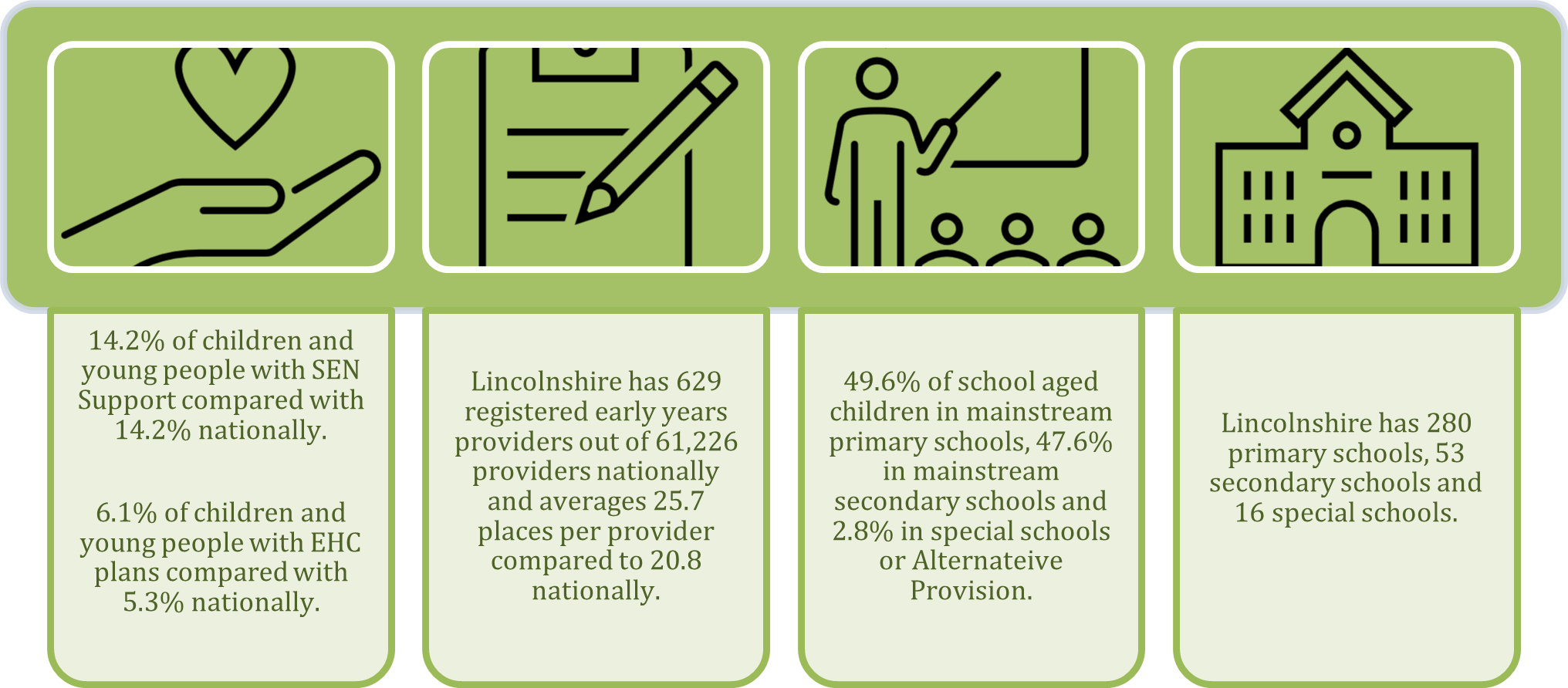
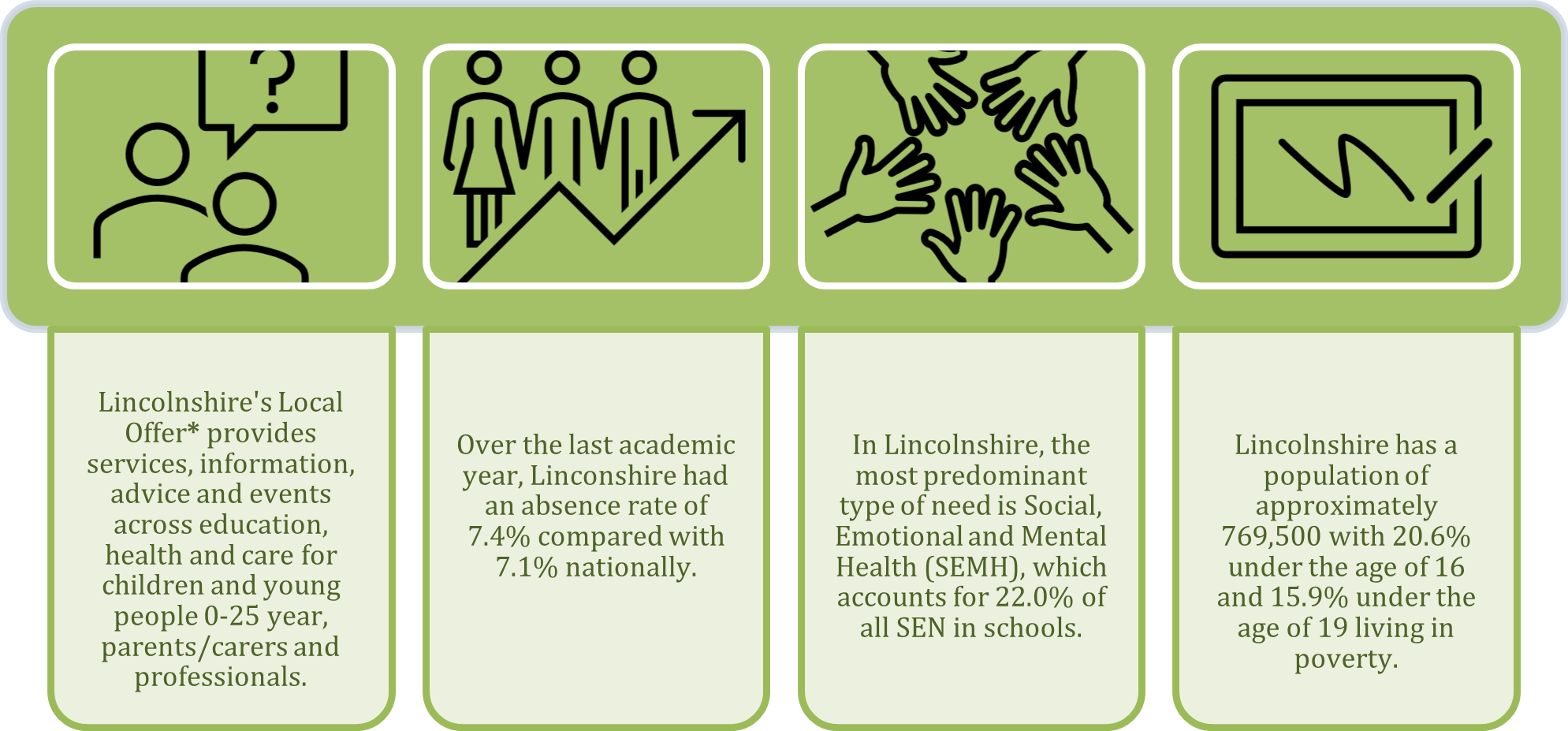
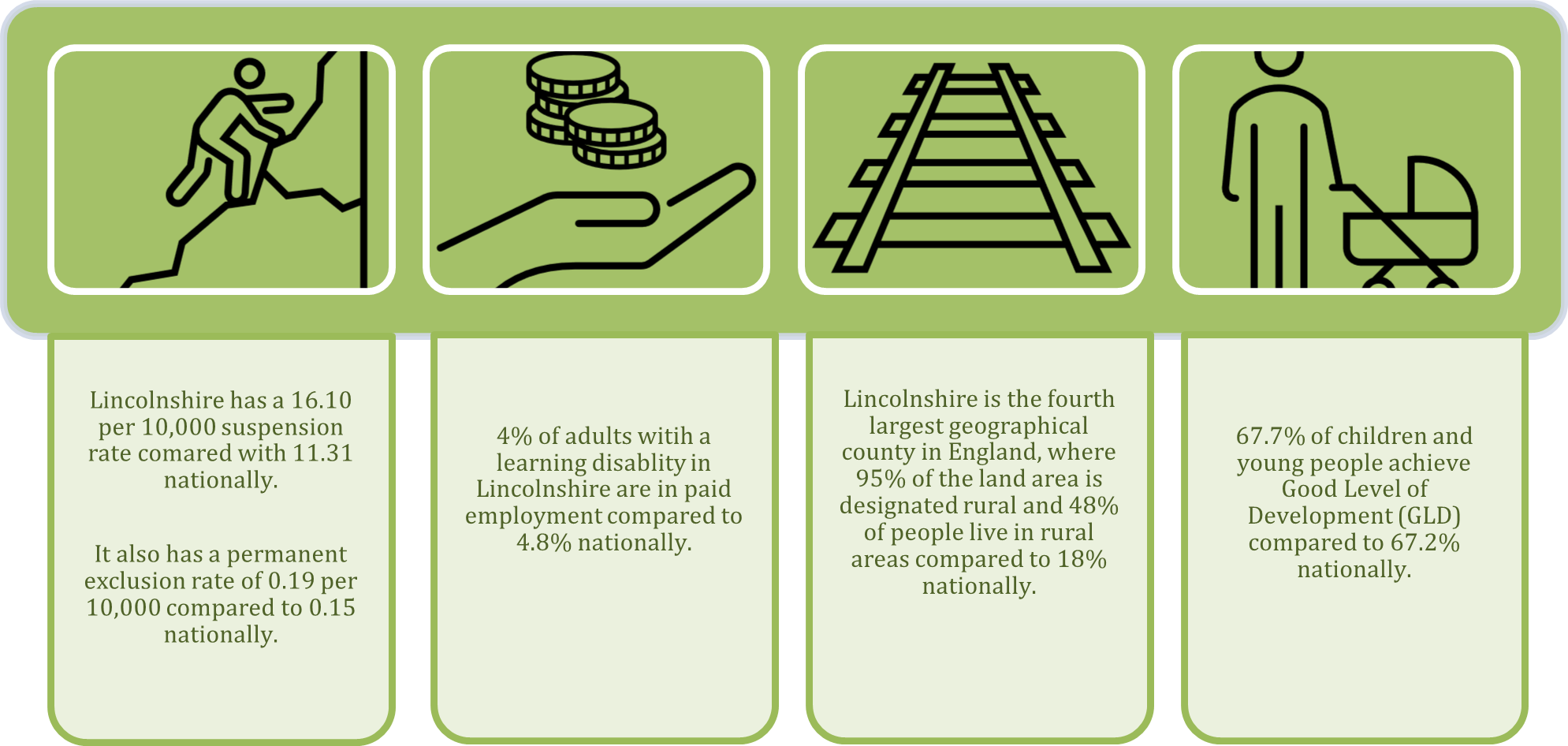
Overview of SEND
|
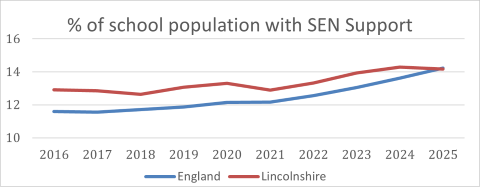
SEN support Since 2014 the percentage of children receiving SEN support has risen both in Lincolnshire, most recently being 14.2% which is the same as the national rate. |
 |
|
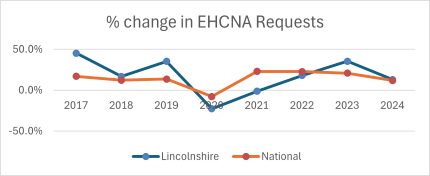
EHCNA requests Since 2017, Lincolnshire has an average yearly growth in requests of 17.4% compared to 14.1% nationally. The bulk of the growth followed the pandemic. 53% of Lincolnshire requests are made by schools. |
 |
|
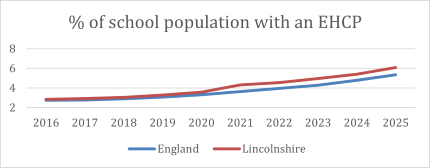
EHC plans Since 2016, the percentage of the school population with an EHCP or statement has grown from 2.9% to 6.1%. This is a larger rate of growth when compared to a national growth from 2.8% to 5.3%. |
 |
|
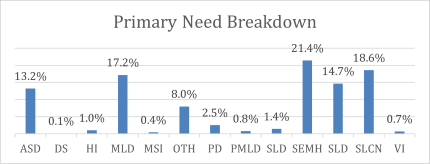
Primary need |
 |
Outcomes
Overview
Children with EHC plans do less well than their peers without EHC plans in all key stages and subjects, which reflects the national picture.
SEND pupil performance in Lincolnshire shows mixed trends across key stages. While there are some improvements due to the strength in provision, particularly for EHCP pupils in early years and phonics, SEN support pupils are consistently underperforming compared to national and regional benchmarks, with widening gaps in certain areas.
Early years foundation stage profile (EYFSP)
- non-SEND:
- 74% achieved a good level of development (GLD), 4% below national
- SEN support:
- 21% achieved a good level of development (GLD), 6% below national
- performance dropped by 3% from 2024, while comparators improved
- the gap between SEN support and the non-SEND children is 4% bigger in Lincolnshire (54% below) than at national (50% below)
- EHC plan:
- 4% achieved GLD, in line with national but much lower than non-EHCP children
- improved by 2%, outperforming comparators
- the gap between EHCP and the non-SEND children is 3% smaller in Lincolnshire (70% below) than at national (73% below)
Key Concern: SEN support pupils are falling behind all comparators. Pupils with EHC plans still do not perform well.
Year 1 phonics
- non-SEND:
- 88% met expected standard, in line with national
- SEN support:
- 49% met expected standard, 3% below national, but improved by 3% from 2024
- the gap between SEN support and the non-SEND children is 3% bigger in Lincolnshire (39% below) than at national (36% below). However, the size of the gap is falling
- EHC plan:
- 21% met expected standard, in line with national
- the gap between EHCP and the non-SEND children is in line with national in Lincolnshire (67% below) compared national (68% below)
Positive trend: Both SEN support and EHC plan pupils improved in the same pattern as national and local neighbours, but overall their outcomes ae much lower than non-SEND pupils.
Key stage 2 SATs
- non-SEND:
- 71% achieved expected standard in reading, writing and maths combined, 2% below national
- now ahead of our other comparators
- SEN support:
- 23% achieved expected standard in reading, writing and maths combined, 5% below national
- gap with comparators is widening.
- the gap between SEN support and the non-SEND children is 4% larger in Lincolnshire (48% below) than at national (44% below)
- EHC plan:
- 8% achieved expected standard, broadly in line with regional neighbours. 1% below national
- the gap between EHCP and the non-SEND children in Lincolnshire is in line with national (63% below)
Key concern: SEN support pupils significantly underperform; EHC plan pupils' outcomes stable but remain low.
Key stage 4 GCSEs
- non-SEND:
- 71% achieved grade 4+ and 48% grade 5+, now below national after recent declines
- SEN support:
- 36% achieved grade 4+ and 20% grade 5+, now below national after recent declines
- the gap between SEN support and the non-SEND children for grade 4+ is 1% larger in Lincolnshire (35% below) than at national (34% below), and for grade 5+ is 1% smaller in Lincolnshire (28% below) than at national (29% below)
- EHC plan:
- 13% achieved grade 4+ and 6% grade 5+, now 2% below national
- the gap between EHCP and the non-SEND children for grade 4+ is the same in Lincolnshire and at national (58% below), and for grade 5+ is 1% smaller in Lincolnshire (43% below) than at national (44% below)
Key Concern: declining trend for SEN support; EHC plan pupils still show limited progress and attainment.
Inspections:
Lincolnshire's children's services received a consecutive Ofsted outstanding rating in April 2023, recognising excellent practice and high-quality leadership. Since this full inspection, when children’s services were judged to be outstanding overall but good for the experiences of care leavers, Lincolnshire’s leaving care service received a focused visit in July 2025. Ofsted found that leaders have been resolute in their quest to improve services for care leavers. Tangible progress was recognised to have been made as a result of relentless determination and an effective transformation programme, that had resulted in the care leavers’ service being insourced.
The Ofsted and CQC Area SEND inspection of Lincolnshire Local Area Partnership took place in February 2025. The inspection recognised the clear governance structure in place that provides effective strategic oversight of services across education, health and social care, the partnership’s ambition for children and young people with SEND, active engagement of stakeholders in decision-making, and effective support for young people with SEND to reach steps to education and employment.
There are aspects of the impact of the partnership’s work to support children’s and young people’s lived experiences that is inconsistent. The inspection recognised the partnership’s shared determination to improve the education, health and social care services that support children and young people with SEND across Lincolnshire. This document sets out this ongoing journey.
Lincolnshire's inclusion priorities
Lincolnshire provides a wide and diverse range of support for children and young people with special educational needs and disabilities aged 0 to 25 and their families.
This is achieved through close partnership working and coproduction.
Through partnership working and in response to Lincolnshire’s current context, achievements and outcomes the following priorities have been identified:
- making support work for families
- inclusive school environments
- prepared for adulthood
- championing positive experiences
- improving the range and quality of provision
These priorities outline how the local area will continue to make improvements that ensure children and young people get the right support, at the right time, in the right place.
Strategic elements
Children's integrated commissioning strategy for special educational needs and disabilities (SEND) services across Lincolnshire
Lincolnshire County Council (LCC) and NHS Lincolnshire Integrated Care Board (ICB) are strategic partners that work together to improve support for children and young people with SEND and their families, across a wide range of education, health, and care services.
The integrated commissioning strategy for children and young people’s SEND services in Lincolnshire sets out our shared aims and objectives for working together to commission services that improve outcomes and reduce inequalities for children and young people with SEND in Lincolnshire.
SEND workforce development programme
The programme draws together resources and training opportunities for people in Lincolnshire who support children and young people with SEND.
It is written by schools for school communities, both mainstream and special, to ensure a culture of SEND awareness and inclusion is embedded in all aspects of school life. New training continues to be developed in response to areas of need within the school communities.
All the training can be accessed via the Lincolnshire Safeguarding Children Partnership (LSCP). As part of the coproduction with Lincolnshire Parent Carer Forum (LPCF) it was identified that parent/carer access to elements of the training would support them to enhance their skills and knowledge with the aim of empowering them through expanding their expertise. Or in the words of LPCF, help parent or carers “become their own professionals”. Access to these aspects of the training is via the LPCF.
Better belonging: SEND sufficiency strategy
The better belonging: SEND sufficiency strategy provides an inclusive targeted framework of SEND and alternative provision across Lincolnshire, developed across all key phases of education and ensuring that new developments are responsive and equitable.
By embedding enhanced learning provisions, resource base provisions, and SEND and alternative provision hubs within mainstream schools, Lincolnshire is creating a tiered system of support that promotes inclusion, reduces segregation, and strengthens community ties.
With a strong emphasis on community developments that are informed by data intelligence, the strategy’s ambition is for child and young person with additional needs to have access to high quality tailored provision that enables them to thrive in local provision and continue to access education within mainstream settings.
Joint strategic needs assessment (JSNA)
Lincolnshire’s JSNA provides a picture of current and future health and care needs of the local population, by collating a range of evidence in one place.
This evidence informs and guides the planning and commissioning of health, well-being and social care services within Lincolnshire.
The Health and Wellbeing Board has a statutory responsibility to prepare a joint strategic needs assessment for Lincolnshire. It is compiled in partnership with local health and wellbeing providers and commissioners, including local authorities, NHS, Healthwatch and other community organisations.
It collates a range of evidence in one place that informs and guides the planning and commissioning of health, well-being and social care services within Lincolnshire.
The identified priorities are then used by the Health and Wellbeing Board to inform the Lincolnshire joint health and wellbeing strategy. By taking this collaborative approach, local partners are clear of the ways in which they can work together to improve health and wellbeing and reduce inequalities in the local population.
Early childhood strategy
Lincolnshire’s early childhood strategy has been developed to capture our collective ambitions for our children and to outline our direction of travel for our improvement journey.
This will enable all stakeholders and professionals to consider how they invest time and resources to best prioritise the areas that will have greatest impact on improving educational outcomes for all children and their families.
The emphasis of the strategy is to establish a shared responsibility amongst all professionals to ensure they play a part in supporting all children to thrive. This will enable the key steps to be in place supporting positive experiences for both children and their parents. This will lead to a smooth transition into school in order that they are ready to learn and are able to reach their expected level of development at the end of their foundation stage.
All-age autism strategy
The All-age autism strategy sets out our objectives and strategic direction to support autistic people of all ages and their families, so that they have an equal opportunity to lead fulfilling and rewarding lives.
It outlines our commitment in Lincolnshire to do more to help autistic people and how we intend to deliver at a local level on the objectives set out within the national autism strategy.
The Lincolnshire Autism Partnership Board (LAPB) is responsible for overseeing the delivery of this strategy. It consists of a range of representatives from partner organisations and stakeholders, who work in collaboration to drive this agenda forward and develop ways of improving services and support for autistic people.
Early help strategy
For children and young people that need additional support, the actions taken by professionals to meet these needs as early as possible can be critical.
Lincolnshire’s early help strategy identifies the need for timely support for children and their families as soon as difficulties start to emerge, or when there is a strong likelihood that difficulties will emerge in the future.
Lincolnshire’s early help offer is not just for young children, as problems may emerge at any point throughout childhood and adolescence.
The early help offer includes universal and targeted services designed to reduce or prevent specific difficulties from escalating or becoming entrenched.
School attendance strategy
Lincolnshire’s school attendance strategy puts a focus back onto school attendance and the importance of this to ensure the safety, wellbeing and achievement of all our children and young people.
Evidence suggests that children and young people who have good attendance are much more likely to achieve academically and go on to lead healthier, wealthier lives.
This strategy focusses on improving attendance for children of statutory age, starting in early education and continuing into post 16 education provision.
Inclusion priority 1 - making support work for families and communities
We want every child and young person and their families to receive the right support, at the right time, in familiar local settings.
Support should be easy to access, without delays or barriers.
We are enhancing early support and intervention to meet needs before they escalate, reducing reliance on specialist services.
Our local offer will be clear, visible, and easy to navigate for families and professionals.
What we have achieved so far:
- Lincolnshire’s local offer has continued to be developed by the multi-agency local offer working group to further expand its information and use by families and professionals
- the family hubs have continued to be developed to meet identified needs, with further opportunities for multi-agency work taking place to identify and meet needs through earlier interventions
- as part of the family hub programme, antenatal Solihull sessions have been developed and are in place across the family hubs and children centre networks. They are offering face-to-face groups delivered at times most suitable to prospective parents, such as evenings and weekends. These supplement the current online offer
- through the family hubs programme, a speech and language early support offer for children in their early years aged three to four years has been piloted within Lincolnshire’s children's centres. There are over 800 families accessing this offer, with positive feedback regarding the provision and support they received
- we have developed home learning environment outreach support to early years settings through our professional development offer for settings. This includes a sustainable approach for making it real through a train the trainers approach, which is being delivered countywide
- we have developed quality 0-2 years provision support as part of the childcare reforms. Nearly 800 families have been supported via this offer, which is continuing to narrow the gap with national levels in ‘good level of development’ outcomes for children with SEND at the end of their foundation stage
- following the release of the best start for life Government strategy in July 2025, we have started the work to further enhance our support and provision through the development of Lincolnshire’s new best start for life strategy
- the inclusion quality and effectiveness team has been set up in direct response to feedback from school leaders. The team will be providing strategic support for Lincolnshire’s mainstream schools to effectively meet the additional needs of their pupils and increase school confidence in their ability to do this
- partnerships for inclusion of neurodiversity in schools (PINS) is a national needs-led project. It brings together health, education, and parent, carer specialists to test a new model for supporting good outcomes in mainstream schools for neurodivergent pupils. Lincolnshire, with Lincolnshire Parent Carer Forum (LPCF) playing a lead role, participated in the initial year of the project, focusing on strengthening knowledge, skills and environments to better meet the needs of neurodivergent children
- every school in Lincolnshire has a nominated member of their senior management as their attendance champion. Close working with attendance champions has meant that every school has a single point of contact for attendance, and training. Guidance delivered by the local authority has equipped them to ensure that early identification of poor attendance remains a priority for all schools
- attendance of children and young people with an EHC plan has continued to be an area of focus with new processes introduced to ensure attendance remains a priority for these children and young people
What we need to do next:
- Lincolnshire’s local offer will be reviewed and strengthened to ensure it continues to develop as a user-friendly platform that navigates easily and delivers precise, up to date information on available services and resources
- the antenatal Solihull programme will continue to be developed and strengthened, expanding its reach area and accessibility for families, with a stronger focus on supporting first-time parents through the face to face offer across the children centre and family hub networks
- building upon the family hubs programme speech and language assistant practitioner pilot, the speech and language therapy (SALT) service is piloting a move away from specialist speech and language clinic-based support to a specialist drop-in service co-located with partners across the family hub networks for children aged three to four years. This will be considered to further strengthen speech, language and communication support as early as possible to maximise positive impact
- we will continue to expand the early years support offer to two-year-olds. We will enhance the special approach to making it real for parents and carers of children with SEND, to improve the way practitioners work with families, building knowledge and confidence through meaningful early literacy activities to support the early home learning environment and ultimately improve literacy and wider outcomes. Engaging parents in their children's early literacy development has been shown to improve children's outcomes and narrow attainment gaps
- following the release of the best start for life government strategy, we will enhance our support and provision through the development and publication of Lincolnshire’s new giving every child the best start in life strategy. The strategy will identify key areas of development to support children to achieve a good level of development and will be developed in alignment with the new family help strategy
- we will review our best start Lincolnshire and other commissioned early years services that delivery across our children’s centre and family hubs networks in order to ensure these service are aligned to updated local and national strategies to further strengthen our fully inclusive commissioned early years offer that supports all children to achieve a good level of development, including children with SEND
- we will develop new early years SEND effectiveness advisors to maximise the help available to families. Each family hub will have a children and family services professional specifically trained in working to support parents and carers of children with SEND who may need extra help early on
- the early years SEND inclusion funding enables early years settings to access top up funding where there is a need to implement additional resources as part of robust early intervention for children with SEND. We will review and strengthen this process, moving to an automated system from a current paper-based process
- the inclusion quality and effectiveness team will embed their offer, working collaboratively with mainstream school leaders to effectively meet the additional needs of their pupils and increase schools’ confidence in school’s ability to do this
- health Visitors will increase the number of antenatal contacts being delivered in Lincolnshire, whilst continuing to offer 100% of the mandated contacts, which include the antenatal (from 28 weeks of pregnancy), the primary birth visit (day 10-14 after birth), 6-8 week, 8-12 month and 2-2 ½ year assessments
- to determine the future commissioning of services we will complete a review of our commissioned services that provide early intervention, such as behaviour outreach support service (BOSS) and autism learning difficulties outreach service, and that provide disagreement resolution, such as regional SEND mediation, advice and disagreement resolution service
- Lincolnshire will embed the learning from the partnerships for inclusion of neurodiversity in schools (PINS) project with a focus on further strengthening knowledge, skills and learning environments to better meet the needs of neurodivergent children
- we will continue to work together to improve school attendance across Lincolnshire and embed a whole school approach, with a ‘support first’ ethos, in tackling attendance issues
- we will continue to support and develop schools in interrogating their whole school attendance data, which is now readily available to them via the Department of Education (DfE). We aim to ensure that all children in Lincolnshire attend school regularly and best practice guides will be shaped by data, helping to pinpoint key areas for improvement
- we will review and evaluate current established mechanisms for communicating with partners across the sector to understand what is working effectively and what is not, so that all stakeholders are informed and knowledgeable about systems, processes, and provision available to support children and young people with additional needs
- the partnership will continue to support and challenge schools in the early identification of children and young people’s needs, further collaborating with school leaders to support and challenge schools to provide early intervention to reduce suspensions and permanent exclusions of children and young people
Inclusion priority 2 - inclusive school environments
We are committed to creating inclusive school environments where children and young people feel they belong and can thrive. By understanding their needs and working together across services, we aim to meet challenges early, so exclusion becomes a last resort, not a routine response.
What we have achieved so far:
- Lincolnshire’s SEND workforce development platform provides resources and training opportunities for those who support children and young people with SEND. It is written by schools for school communities. The platform has been updated, incorporating an expansion of sixteen additional modules phased online during 2024-25 and 2025-26. Detailed analysis of outcomes has shown a correlation between completion of modules and an increased ability to meet additional needs
- a multi-agency review of Lincolnshire’s ladder of behavioural intervention, a framework to support schools in managing pupil behaviour, has taken place, strengthening the ladder to further reinforce its application by schools. Key focusses have been early warning signs and intervention, good practice expectations, robust preventative whole school approaches and a toolkit to provide schools with resources to implement the ladder effectively
- a joint multi-agency data dashboard has been developed by the local authority and health partners to maximise the use of data to inform commissioning and share meaningful evidence regarding outcomes and provision of services. The data dashboard is live and processes are in place for regular updates and publishing of the data, ensuring families and professionals have clear understanding of Lincolnshire SEND population in early years, school, post 16 and adult care. It also includes data for children’s therapy services, neurodevelopmental pathways, learning disability, dynamic support register and mental health services
- we have introduced SEND hubs and alternative provision hubs. The hubs have been created as part of strengthening our mainstream offer; run by mainstream schools as an integral part of their school. The coproduced provisions are aimed at providing personalised educational delivery across the curriculum to support children and young people as they progress through their educational journey
- children's continuing care and the children with disabilities (CWD) social care team continue to further develop collaborative working to ensure that children and young people with complex health and care needs receive the right support at the right time. The panels are held on the same day with a respective representative from health and from care on each panel
- Lincolnshire’s electronic EHC hub has been widened from completing all EHC needs assessments to also complete all annual reviews of EHC plans, further widening the transparent way of working and access to information for parents, carers and children and young people with a significant level of SEND that require an EHC plan
- the SEND health quality assurance panel has demonstrated an improvement in clinical report writing. It has been a substantive programme of work within the NHS Lincolnshire integrated care board (ICB) and provider organisations and feeds into the wider EHC plan quality Improvement audit programme
- the review of alternative provision is drawing to a conclusion with the findings and information being carefully analysed and considered to support identification of actions and steps to provide mainstream schools with the appropriate support so that exclusions are only ever issued as a last resort
- mainstream schools have been developing their own internal provision to meet the additional needs of their pupils, with a focus on national plans by the Government and the DfE so that Lincolnshire continues to drive forward effective and efficient support and provision
- the local authority increased the availability of alternative provision with a capital build, refurbishing Myle Cross in Lincoln expand Springwell Lincoln. The increased 54 places have been utilised to support the high number of pupils being excluded
- Lincolnshire’s commissioned behaviour support review has been taking place. Positive regard, part of the Wellspring Academy Trust that provides the majority of Lincolnshire’s alternative provision, has been working collaboratively with secondary school leaders to identify effective school improvements to enable them to proactively manage pupil behaviour within their settings
What we will do next:
- the updated SEND workforce development platform will be further embedded across educational settings with access to the additional sixteen additional modules that are being phased online. Detailed analysis will continue to identify further correlations around increasing school’s ability to meet additional need in schools
- Lincolnshire’s reviewed and updated ladder of behavioural intervention will be embedded within our mainstream schools, with the pupil reintegration team (PRT) providing ongoing training and support
- there will be continued updating of the joint multi-agency data dashboard. Further refinement will take place as part of business as usual to review, develop and improve the use of data, maximising its impact in informing commissioning through meaningful evidence regarding outcomes and provision of services
- Lincolnshire will continue to drive forward the introduction of SEND hubs and alternative provision hubs. They will continue to be coproduced through the local partnership, building on those already developed, sharing good practice and exploring further opportunities to maximise high quality mainstream provision. The provisions will provide personalised educational delivery across the curriculum to support children and young people to remain in mainstream education where possible
- children's continuing care and the children with disabilities (CWD) social care team will continue to further develop and grow collaborative working to maximise positive decision making and impact
- Lincolnshire’s electronic EHC hub will continue to be embedded and strengthened as part of business as usual to provide robust, efficient, effective and transparent support for processing EHC needs assessments and the annual review of EHC plans
- the review of alternative provision will be completed and the findings analysed to support identification of actions and steps. The findings will be considered alongside national plans by the government and the DfE to support effective decision making regarding the development of support and provision in Lincolnshire
- Lincolnshire’s commissioned behaviour support review will be completed and secondary schools will take forward the learning and positive developments within their settings. It is extremely positive that not all secondary schools in Lincolnshire are issuing high numbers of exclusions. Good practice will be identified, celebrated and shared and the Review will be used to review the range of available support and inform adaptions.
- Lincolnshire’s Future4Me supports children at risk of being in the criminal justice system and/or committing crimes. Teams within Future4Me, inclusion, and attendance will develop and embed a joint working protocol. By working together, we can tackle challenges more efficiently, develop innovative solutions, and achieve common goals that might be difficult to reach individually. This approach promotes collaboration, strengthens relationships, and enhances outcomes
- when schools notify the local authority of ‘pupil not attending regularly’ the attendance team will set up automatic notifications for children who are open to Future4Me, to enable exploration of the reason for absence and provide support to the setting to address the absence
- when a parent or carer is considering home education, the attendance team will support with a meeting in school, to ensure parents are able to make a fully informed decision, as to whether home education is the right choice for their child
- our ethnic minority and traveller education team will continue to help schools to identify the needs of children and young people, and, where appropriate, will connect them to support
- we will realign the roles of children and young people's nurses in the children's 0-19 Health Service to deliver the healthy child programme, with a focus on support for children and young people with long term health needs or medical conditions impacting their ability to engage in education
Inclusion priority 3 - prepared for adulthood
We want children and young people in Lincolnshire to be supported to achieve their best in school and in life. Through strong planning and support, we will help them build the skills, confidence, and resilience to move successfully into adulthood and independence, with high aspirations guiding every step.
What we have achieved so far:
- the careers hub has completed the pilot to support primary schools to achieve higher aspirations, aimed at pupil’s own thinking about what jobs are possible and challenging stereotypes that may be limiting. “start small – dream big” has been rolled out across 63 primary schools, with each school appointing a lead teacher, who has completed development modules around leadership, employer engagement, challenging stereotypes and parent partnership support. Resources have been developed and distributed to participating schools, with region-wide access to MyPath careers, a fully funded video library linking the national curriculum to real-world jobs and skills. Feedback has been overwhelmingly positive, including relevance, usability, and pupil engagement with early indicators of increased teacher confidence in embedding careers learning at key stage 1 and 2.
- health visitors have continued to ensure those most in need are seen on a targeted basis to ensure early intervention and prevention is part of business as usual, including targeting those most vulnerable
- the SEND team have been expanded by a further 15 caseworkers to increase the capacity of the team to meet the continued increase in demand
- the transition team, part of the pupil reintegration team (PRT), has been established to support pupils to transition from alternative provision, special school, or interim home tuition back to mainstream via Lincolnshire’s transition protocol. The team have built relationships with alternative provisions and schools, developing collaborative working to identify pupils suitable for transition support, with parents, carers and children and young people at the centre of discussions and decision-making
- a project is underway to support young people to transition back to Lincolnshire from out of county independent special school settings as part of their preparation for adulthood
- the leaving care service has been insourced and brought under direct council provision, strengthening our offer to care leavers, particularly those aged 21 and over. This enhanced support has been positively recognised during the recent Ofsted focused visit, where inspectors highlighted the clarity and ambition of our 21+ offer. The newly established post-16 education, employment and training (EET) service has already begun to demonstrate positive outcomes, with early evidence showing improved engagement and progression for care leavers. The service is also placing greater emphasis on addressing mental health and substance misuse needs, which are often barriers to sustained EET participation
- the special schools have engaged well with the SEND employment project, and this has enabled them to focus on careers, work experience and employment opportunities across the county. Special schools with post 16 provision have had employer encounters, work experience (internal and external) and are moving students onto appropriate employment pathways including adults local supported employment programme
- the children in care (CiC) employment project pilot has been completed and as a result of the outcomes achieved, permanent posts have now been created via the virtual school to continue taking this forward
- the supported employment project assisted InspireU to successfully apply for Whitbread’s Thrive programme. Four young people have been through the programme and are all now in permanent paid positions at Premier Inn, with a further eight young people going forward on this pathway to paid jobs
- Lincolnshire County Council have been selected as one of the next wave of partners to receive its own Premier Inn training facility. The facility is being housed at the InspireU Lincoln site and is fully funded by Whitbread. The facilities are a complete replica of a Premier Inn, consisting of a reception area, three fully furnished bedrooms and bathrooms and a team area equipped with laundry facilities. The training facility will be open to the wider community, including special schools, colleges and adults day opportunities
- we have strong gathering of information around children and young people considered NEET (not in education, employment or training). We have continued to make links with other local authorities for sharing of good practice and preparation for adulthood communications to young people and parents and carers
- the intake team and the physical disability team have merged to become the preparation for adulthood team, a single team to support young people transitioning to adult social care. The team will continue to enhance collaborative working to ensure transitioning young people have timely assessments and their families are clear about the support they will receive on reaching adulthood
- ensuring clarity of information for families about transitions to adult social care will continue to be embedded and reviewed within Lincolnshire’s local offer so that expectations are clear from an early age, including eligibility, the most appropriate pathway for transition and what to expect
- the leaving care service has been working closely with adult social care to enhance the transition process for young people moving into adulthood from children in care (CiC) to leaving care. This has involved strengthening collaboration across services to ensure timely assessments and clear communication with families about the support available. We have reviewed the referral process to improve efficiency and ensure that pathways into adult social care are well understood. The work is being embedded within Lincolnshire’s local offer, helping to set clear expectations from an early age around eligibility, transition pathways, and support families can expect
What we need to do next:
- the support for primary schools via the careers hub will continue to develop and grow. Commission complete careers will run primary careers community of practice meetings, maintaining peer-to-peer networking and best-practice sharing. Ongoing feedback will be gathered from the primary school career leads to refine and strengthen the parental engagement pack and MyPath resources. Impact will be gathered and published. Sustainability options will be explored and additional local partnerships to secure long-term primary careers support
- the transition team will continue to work in partnership with families, alternative provision and schools to ensure a supported transition for pupils back to mainstream via Lincolnshire’s transition protocol. All school settings have committed to the protocol and their commitment will be demonstrated via the strength of their support, engagement and drive in ensuring children and young people are provided the advantages of timely access to mainstream education
- we will progress with the project to support children and young people transitioning from out of county independent special school settings back to Lincolnshire, supporting and enabling young people to return to their local community as part of their preparation for adulthood
- the leaving care service will continue to be embedded within the council’s direct delivery, further enhancing the quality of pathway plans, which include up to date, clear, time-bound actions to promote young people’s welfare, progress and safety. Strengthened case recording, to capture significant events, help workers and young people understand post-care journeys and inform planning will also be a key focus
- Lincolnshire’s SEND employment project has developed the employer market and employment opportunities for children and young people with SEND. The vocational profile tool is being used widely by the special schools and has supported young people to identify their aspirations and to work towards achieving these. The tool will be rolled out to mainstream learners with EHC plans to support them on their vocational journey
- the Premier Inn training facility at the InspireU Lincoln site will be completed for access by the wider community, including special schools, colleges and adults day opportunities. A working group is being led by InspireU, to ensure use of the facility is maximised. Work will take place with the careers team to roll out a work experience offer for year 9 and year 10 pupils
- we will complete the supported accommodation review to determine future in-house and commissioning requirements to inform and guide decision-making for maximum positive impact
- development of new transition work streams will take place through joint multi-agency working and coproduction with adult care and community wellbeing. These are aimed at strengthening and improving transition support, pathways, information and communication
Inclusion priority 4 - championing positive experiences
We want children and young people and their families to feel they belong, are valued, visible and included in their communities. We aim to ensure that children and young people and their families participate and are actively engaged in decision-making about their plans and their support.
What we have achieved so far:
- Lincolnshire Parent Carer Forum (LPCF) membership has increased massively as more and more parent/carers join their membership; over the last 12 months it has risen by 23%, further strengthening their insights, knowledge set and expertise
- LPCF has continued to deliver a ‘week of SEND’ event each January, which has been further supplemented by a variety of workshops throughout the year. These have continued to be aimed at parents and carers of children with disabilities and additional needs and professionals who work with them
- LPCF continues to be a joint partner, coproducing local authority strategic decision-making and developments for children and young people with SEND. For example, lincolnshire’s inclusion strategy, Lincolnshire’s SEND Ofsted improvement plan, and the review of Lincolnshire’s ladder of behavioural intervention to name but a very small few
- LPCF have developed a working group that benefits from the expertise of parent and carers, lived experience, SENCos, and school leader experience. The mix of experiences across their volunteers means their discussions and findings are robust, evidence-based and constructively challenging. The group is working with stakeholders to fully explore the reasoning behind why some parent and carers see an EHC plan as a ‘golden ticket’ and lack confidence in mainstream school
- the LPCF state of SEND Surveys were published in January and stakeholders across the local area, including the local authority, health, schools and charitable organisations all helped to publicise the survey. The findings provide invaluable insights into our local area and informs decision-making
- LPCF produce a quarterly parent voice report that they share with partners in the local authority. LPCF highlights that this information and evidence is consistently responded to, demonstrating how LPCF feedback is valued
- Lincolnshire young voices (LYV) researched and developed resources around transport and independent travel training, based on student interviews and research. Their transport survey had over 600 completions, the group held meetings with LCC transport managers and bus operators, and the findings were shared at the highways and transport scrutiny committee. As a result, some coach operators have changed their policy regarding transport for people with a disability and are installing additional disabled space. Resources have been developed and are available to download on the family services directory
- the bullying alliance states that around 37% of children and young people with SEND experience bullying. LYV’s have worked with schools to seek insight, views and experiences. As part of anti-bullying week, LYV delivered a series of workshops to Lincolnshire special school settings; 16 anti-bullying sessions in 7 settings to over 170 students. Workshop feedback was positive with sessions both informative and interactive. LYV produced a range of school-based resources that are available on the family services directory, and schools are encouraged to use them
- Liaise have continued to review how calls and emails into their service are handled, using data analysis to enable them to continue implementing meaningful improvements that maximise the support available to parents and carers. They have developed and implemented a yearly quality assurance programme and reviewed how they process and support referrals into the service. The findings identified areas for improvement and the actions and changes implemented as a result
- Liaise have continued to widen their offer and support, developing links and engagement with special schools and day care centres. They have further developed and improved their accessibility for young people, including embedding stronger links with FE colleges and ensuring Liaise caseworkers have up-to-date robust knowledge of post 16 processes and provision. LYV have reviewed the Liaise online contact form and provided feedback to support amendments. These have been completed, and bespoke training delivered to the service to embed knowledge of post 16 law
- we have continued to analyse our data to inform developments regarding appeals lodged with the SEND tribunal. SEND performance meetings take place monthly with data analysis supporting senior manager decision-making. SEND caseworkers are working closely with families to try and resolve disagreements at an earlier point to ensure that this adversarial route is avoided where possible for families
- the gathering and evaluation of EHC plans and processes level of satisfaction feedback has continued to be strengthened. Collaborative working with LPCF has enhanced practices, with evaluation of the LPCF surveys part of business as usual. We have developed surveys that are live and linked to letters sent to families from the electronic EHC hub. Themed development days take place from the feedback to develop the SEND workforce
- the SEND team have set up a screening process for mediation requests to try and resolve disagreements at an early stage to prevent escalation. The team also aim to manage any complaints with more contact with families to discuss concerns and implement actions to resolve issues and try to prevent further dissatisfaction
- we have worked with the regional mediation advice, mediation and disagreement resolution service and used both local and regional data to identify trends in SEND related disputes. This insight is being used within the review to guide our decision-making ahead of any extensions and to help us improve how we support children, young people, and families
- where a child or young person requires a bespoke package of support we have continued to develop and implement robust processes to ensure consistency and oversight of risk management for unregulated providers. The educated other than at school (EOTAS) panel has been established. It sits weekly and has oversight of all packages to ensure consistency and risk management. The SEND team also work closely with commissioning to monitor these providers and ensure checks are undertaken. All packages have management oversight and agreement
- all schools in Lincolnshire have signed up to work with the attendance team, to improve school attendance. Working in collaboration with multiple service areas, the attendance team provide support for all schools and facilitate cluster meetings across the districts. Cluster meetings bring together a range of professionals and services who are working in partnership to address barriers to attendance
What we need to do next:
- LPCF are a key partner in developing and embedding a robust quality assurance framework to ensure EHC plans consistently meet a high standard. They will continue to provide crucial insight and constructive challenge from their experiences, knowledge and skills that will inform robust decision-making and developments
- LPCF will publish the findings from their state of SEND surveys and present them to partners across the local area and key stakeholders. These will be used to inform and coproduce service developments
- aspirational thinking among families of children with SEND is a recognised focus for LPCF and they will continue to encourage this. They will also design and deliver an additional workshop within the juggling the joys of parenting’ series
- LYV will work closely with SEND to explore how children and young people experience EHC plans, needs assessments, annual reviews, and the support they receive in education. LYV has developed a survey to gather views from children and young people, with support from school staff where needed
- The feedback will be used to:
- identify how well children and young people feel involved in shaping their plans and support
- highlight areas where LYV can develop resources to promote greater inclusion and participation
- ensure future tools and approaches are accessible, meaningful, and reflect the voices of children and young people in Lincolnshire
- LYV will complete a project around accessibility of parks across Lincolnshire. They will report their findings to each local council responsible for each park, to inform developments and actions to take forward
- LYV will work closely with the SEND team to explore how professionals communicate with children and young people. Suggestions will be explored and rolled out to the SEND team to support and strengthen their interactions
- Liaise will continue to develop and improve their accessibility for young people, working directly with young people and building on joint working taking place with LYV. They will undertake a project with LYV to support young people to refer into the service, including redesigning the young people's area of the new Liaise website. They will also develop a young people's zone on their website, working directly with young people with SEND on the content and style of it
- we will ensure the voice of children and young people informs all commissioning reviews and helps shape service decisions, developments and services improvement
- Liaise will develop links with family hubs, to promote the service, and to support both professionals and families to understand how we can further enhance our work with families in Lincolnshire. They will trial Information sessions for parents, carers and expand these out across the family hubs
- we will continue to develop and embed a robust quality assurance framework to ensure EHC plans consistently meet a high standard. This includes improving the quality of information that informs each plan so that it reflects the full breadth of child or young person’s current needs, accurately captures their voice, and supports effective provision planning. We will focus on ensuring plans are informed by up-to-date reports and evidence, and preparation for adulthood and transition planning is clearly considered and delivered in a timely and meaningful way
- we will continue to monitor and support the use of attendance data, ensuring all educational settings actively work to prevent poor attendance through collaborative, multi-agency approaches. The focus will be on strengthening early identification of emerging trends and patterns, ensuring timely, school-based support is available
- we will review and improve collecting and reporting mediation and SEND appeal data to ensure meaningful analysis and trends can be identified. This will help better understand the experiences of families, and inform more inclusive and responsive decision-making across commissioning, service planning and workforce development
- we will continue to monitor and analyse complaints to identify gaps in service delivery and understand the lived experiences of children and young people with SEND, and their families. This will inform inclusive, responsive and person-centred improvements to our services, and enable us to implement targeted developments to strengthen practice, reduce escalation, and build confidence in the SEND system
Inclusion priority 5 - improving the range and quality of provision
We want high quality local support and services across Lincolnshire that provide effective early intervention for children and young people, ensuring access to resources that promote confidence, respect and inclusion. Effective support and inclusive provision that offers the best experiences and outcomes so that children and young people can thrive.
What we have achieved so far:
- the partnerships for inclusion of neurodiversity in schools (PINS) project, with LPCF playing a leading role, tested an innovative model for efficient deployment of specialist health workforce and strengthened effective parent/carer and school partnerships in mainstream education settings to support neurodiverse pupils. The project was delivered in 39 primary mainstream schools in Boston South Holland, with positive feedback from NHS England, schools and families
- where independent specialist provision is appropriate, we have implemented block commissioning arrangements to maximise value for money from spend within the high needs block. This has reduced average placement cost by 11% for blocked commissioned placements, with 15% more children and young people being educated in Lincolnshire placements from 2023-24
- SEND placement management meetings have been embedded, enabling the local authority to look strategically across independent placements and incoming referrals. They consider referrals alongside demand, and facilitate co-ordination of placement sufficiency in both maintained settings and the independent market. This is to ensure that the right children and young people are placed in the right settings and access education as close to home as possible
- children’s integrated commissioning team (CICT) with Lincolnshire community health services (LCHS) NHS trust have completed a review of Lincolnshire’s speech and language therapy (SALT) service and made recommendations for a new model of support
- SALT will continue to prioritise those children and young people with highest need, providing safety netting advice whilst children are waiting for therapy so that the team of support around the child have strategies and programme of work in place
- the extended communication and language impairment provision for students (ECLIPS) team have joined with Lincolnshire’s virtual school to roll out the inclusion project. This pilot involves working alongside school staff to implement ‘language for behaviour and emotion’ intervention. ECLIPS are providing training and support to tailor intervention to meet the language needs of children and young people at risk of exclusion that are under the care of the virtual school. This is expanded to support other pupils in the school and inform whole school approaches to behaviour management linked to the impact language difficulties have on behaviour
- the L.E.A.D. teaching school hub Lincolnshire is one of 87 nationally DfE designated centres of excellence, commissioned by the DfE they have continued to provide high quality professional development and support in initial teacher training, early career guidance and quality assurance, specialist and leadership qualifications, and pathways to retain and develop expertise
- the L.E.A.D. teaching school hub Lincolnshire has continued to embed the DfE accredited tiered approach to SEND professional development ‘how best to support provision in mainstream’ across headteachers and senior leaders, middle leaders, teachers and support staff. 80% of schools worked with L.E.A.D professionals development services, rating the quality as 97% good or better
- the recommissioned early learning and portage service has been embedded and is part of careful monitoring and quality assurance of positive impact, key performance outcomes and value for money for children and their families. The service is also closely linked to Lincolnshire’s family hub offer, maximising the support offer available to children and their families
- we will continue to develop a sensory processing difficulties (SPD) support model. Bespoke SPD workshops are now part of the NHS Lincolnshire integrated care board (ICB)’s core offer and further workshops are scheduled to be delivered for families and professionals
- the children and young people’s mental health transformation programme has been completed, with recommendations to transform and improved provision being embedded over the next 5 years starting in 2025-26
- the rising demand for domiciliary care provision has been met through engagement with specialist domiciliary care providers to match demand with capacity in the marketplace and adjustments to the commission requirements. There has been a significant increase in delivery with care provided in a timely manner
- SEND caseworkers and social workers contribute to care education and treatment reviews (CETRs) and discharge meetings to prevent readmission. The dynamic support register (DSR) meetings have become more confident and focused as individuals understand their roles and the role of their service area in preventing admissions where possible. As a result, the number of children and young people who are in-patients has remained at zero or low throughout the year
- to further support schools with ensuring they implement and maintain robust checks, procedures and oversight of alternative provision arrangements they have in place, we have developed a register for schools to inform the local authority of the providers they are commissioning. The alternative provision guidance document provides guiding principles for Lincolnshire schools, to ensure that children and young people benefit from high quality alternative provision, which is safe, secure and appropriate to their individual needs
- workshops have been completed to develop a new model for neurodevelopmental assessment that will improve support, reduce waiting times and simplify the process for families. While the development of a new model takes place funding investment has been made to improve the autism assessment capacity in 2024-25
- the local authority’s occupational therapy team have invested in additional occupational therapy positions and a dedicated team manager position, to support timely assessments taking place. Robust case triage has continued to take place and waiting times are reduced
- there has been promotion of how personal budgets can be accessed by families of children and young people with an EHC plan, including presentations that took place at the LPCF week of SEND and information on Lincolnshire’s local offer. More families are accessing personal budgets for elements of provision within an EHC plan
- we have continued Lincolnshire’s investment of over £100m in specialist provision, increasing special school capacity by over 500 places. We are awaiting further information from the DfE regarding the announcement that Lincolnshire was successful in their free school bid to build an additional special school to meet children and young people’s social, emotional and mental health (SEMH) needs
- the occupational therapy advice line has been embedded as part of the service’s universal offer, and is open to families, education and medical staff. It will continue to be monitored, reviewed and evaluated to support ongoing developments to maximise available support and its impact
What we will do next:
- we will continue to work collaboratively with the NHS Lincolnshire integrated care board (ICB), the working together team and LPCF to see how lessons learnt from the PINS project can be embedded into existing autism and learning difficulties outreach services. We will consider the national evaluation of the project, due in autumn 2025, and how this can also be used to shape future delivery
- where independent specialist provision is appropriate, we will continue to implement block commissioning arrangements to maximise value for money from our spending within the high needs block
- we will continue to work towards a specialist speech and language therapy (SALT) service delivery model that is sustainable, within available resources and accessible by children and young people and their families
- we will continue to develop new ways of working, ensuring opportunities are maximised to access universal, targeted and specialist support for speech, language and communication needs, including the embedding of a digital platform to support SALT triage and access to advice
- the ECLIPS team will complete the roll-out of the inclusion project, supporting involved school staff with individualised target setting and modelling practice to enable the work to be expanded throughout the schools. The pilot will collate and analyse data to measure impact and inform next steps
- the L.E.A.D. teaching school hub Lincolnshire will continue providing a range of high-quality professional development and support in initial teacher training, early career guidance and quality assurance, specialist and leadership qualifications, and pathways to retain and develop expertise to meet children and young people’s needs
- we will implement the recommendations from CYP mental health transformation programme for 2025-26, including continued expansion of mental health support teams, developing and improving provision, pathways and access to mental health support and services
- we will continue to support schools with ensuring they implement and maintain robust checks, procedures and oversight of any Alternative Provision arrangements they have in place for provision they directly commission. We will consider how we can further strengthen existing tracking and assurance mechanisms
- where there are gaps in our children and young people autism and neurodevelopmental diagnostic pathways, we will develop appropriate commissioning plans and seek to put in place the necessary arrangements
- we will continue to develop plans for how the existing autism diagnostic pathway for children and young people can be transformed to implement a new improved co-produced pathway. While this takes place, funding investment will be made to improve autism assessment capacity in 2025-26
- we will await further information from the DfE regarding Lincolnshire’s successful free school bid to build a new SEMH special school. While awaiting this, we will continue to invest in robust provision to meet children and young people’s needs
- short breaks are designed to give disabled children the opportunity to enjoy activities and experiences outside their home environment, while also providing their families with much-needed respite from caregiving responsibilities. We will open the commissioned Maples short-breaks home to further strengthen Lincolnshire’s short breaks offer
How do we know our plans are working?
How will we measure success?
We will work continue to work closely with Lincolnshire Parent Carer Forum (LPCF), Lincolnshire Young Voices (LYV) and our strategic partners to ensure that children, young people and their families coproduce developments and support in evaluating progress towards milestones:
- improved attendance
- reduced suspensions and permanent exclusions
- robust application of early intervention and support
- increased confidence in mainstream schools and available support
- reduced reliance and demand on specialist support and provision
- increased achievements and positive outcomes
- effective transitions and preparation for adulthood
- positive feedback from children and young people, parents and carers
How will we keep our plan under review?
Lincolnshire’s inclusion strategy and plan will be formally reviewed and updated on an annual basis at the end of each academic year with involvement from all key stakeholders via the SEND learning partnership board and the SEND steering group. Each strategy within this document will be reviewed in line with their timeline and governance.