Lincolnshire demographics
Lincolnshire, located in the East Midlands, is the second largest county in England by area and the eighth largest by population. The county is administratively divided into seven districts:
- Boston
- East Lindsey
- Lincoln
- North Kesteven
- South Holland
- South Kesteven
- West Lindsey
Lincolnshire features a diverse geographical landscape, encompassing extensive rural and agricultural areas, urban centres, and historic market towns. Its eastern coastline is a significant asset, supporting a thriving tourism industry and contributing to the county’s economic and cultural identity.
Population
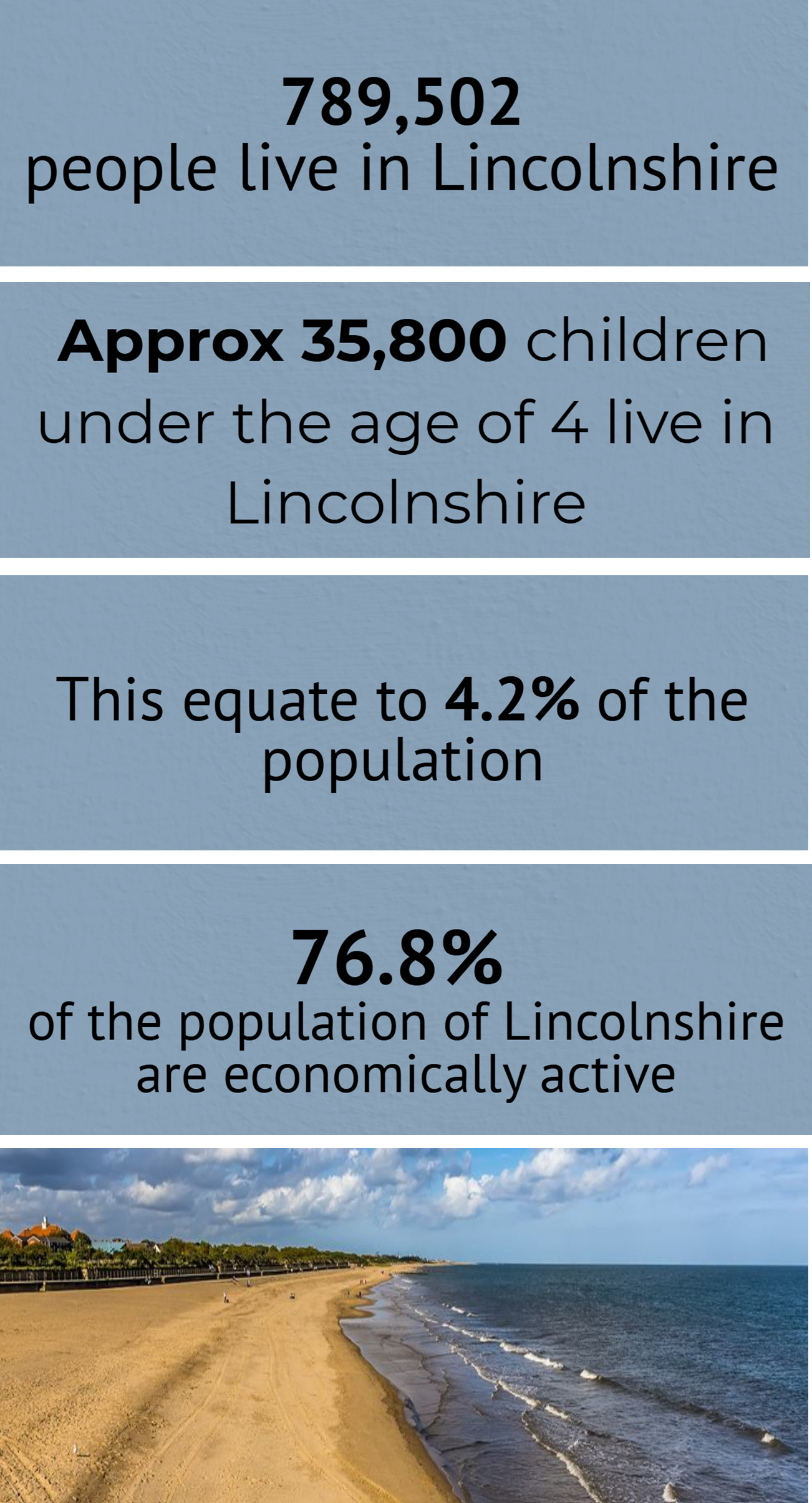
According to the Office for National Statistics (ONS), the estimated population of Lincolnshire in 2024 was 789,502, this reflects a growth of 21,138 people (2.75%) since the 2021 Census.
Children aged 0 to 4 years accounted for 4.5% of the 2023 population, which is 0.8% below the national figures for this age group.
To inform our childcare sufficiency assessment, we utilise population data sourced from NHS SystmOne, which captures information on children registered with general practitioners across Lincolnshire. While minor discrepancies may arise due to variations in GP registration, this dataset is widely regarded as a robust and reliable indicator of the resident child population.
This approach aligns with methodologies used in school place planning and provides a consistent basis for assessing current and future demand for early years and wraparound childcare provision.
According to the latest data from SystmOne, there are approximately 28,300 children below school age across the county who may require access to early years childcare. This figure plays a critical role in shaping our strategic planning and ensuring that provision is responsive to local needs.
Lincolnshire birth rate (data taken from SystmOne)
- 2011 - 7,938
- 2017 - 7,485
- 2018 - 7,017
- 2019 - 6,767
- 2020 - 6,600
- 2021 - 6,559
- 2022 - 6,397
- 2023 - 6,289
Despite the growth of the overall population in Lincolnshire, the East Midlands region and Lincolnshire continues to experience a decline in birth rates. In contrast, the national birth rate has shown an increase for the first time since 2021.
Population demographics
Data from the Department for Work and Pensions (DWP) shows that Lincolnshire has 73.7% of the population economically active, this means they are in employment. These rates do vary across districts.
| District | Percentage of population that are economically active |
|---|---|
| Boston | 68.8% |
| East Lindsey | 68.3% |
| Lincoln | 78.4% |
| North Kesteven | 81.0% |
| South Holland | 78.4% |
| South Kesteven | 71.2% |
| West Lindsey | 71.0% |
This data is a key consideration when assessing the sufficiency of childcare provision. Findings from the 2025 parental survey indicate that the majority of parents access childcare primarily to enable them to work. As such, it is reasonable to infer that demand for childcare is likely to be higher in areas with greater levels of economic activity, where more parents are in employment.
Housing
The National Planning Policy Framework requires local planning authorities to identify a rolling five-year supply of deliverable housing across the period.
Lincolnshire has set out ambitious plans for housing developments across the county by 2031. While planned housing growth is a useful indicator, it does not directly translate into increased demand for childcare. Factors such as average household size, population demographics, and the nature of new housing developments will all influence potential demand.
The impact of housing growth on childcare sufficiency must therefore be considered in the context of local population characteristics. This includes the mix of age groups and family composition, as well as Lincolnshire’s birth rates. These variables collectively shape the scale and type of childcare provision that may be required in the future.
| Location | Developments | Houses | Already built |
|---|---|---|---|
| Boston | 43 | 2,676 | 594 |
| East Lindsey | 95 | 7,596 | 1,988 |
| Lincoln | 22 | 4,022 | 105 |
| North Kesteven | 53 | 6,597 | 1,032 |
| South Holland | 47 | 3,431 | 719 |
| South Kesteven | 34 | 5,356 | 1,236 |
| West Lindsey | 90 | 12,548 | 1,631 |
| Total | 384 | 42,226 | 7,305 |
The increasing uptake of funded childcare entitlements is driving a growing demand for early years provision, particularly in areas experiencing new housing developments. Developer contributions secured through Section 106 agreements play a vital role in supporting the creation of additional early years places for children aged 0 to 4 years.
We have been working in close collaboration with the school strategic development team to ensure that early years provision is fully considered when allocating Section 106 funding. Looking ahead, this integrated approach will help ensure that early years infrastructure keeps pace with population growth, supporting the development of sustainable and well-served communities.
The securing developer contributions for education August 2023 publication identifies local authorities responsibilities for providing sufficient school places under the Education Act 1996 and now also includes early years and childcare. It is also a source of information for local planning authorities and other stakeholders involved in the delivery of schools.
Early years has been included within Lincolnshire’s planning obligations protocol and this will be published in due course. This aims to make clear to all stakeholders, our requirements towards infrastructure and services that will be expected alongside new developments. It provides clarity, particularly for landowners and developers, but also others, including the district councils and town and parish councils across our county.