Affordability
Costs for parents
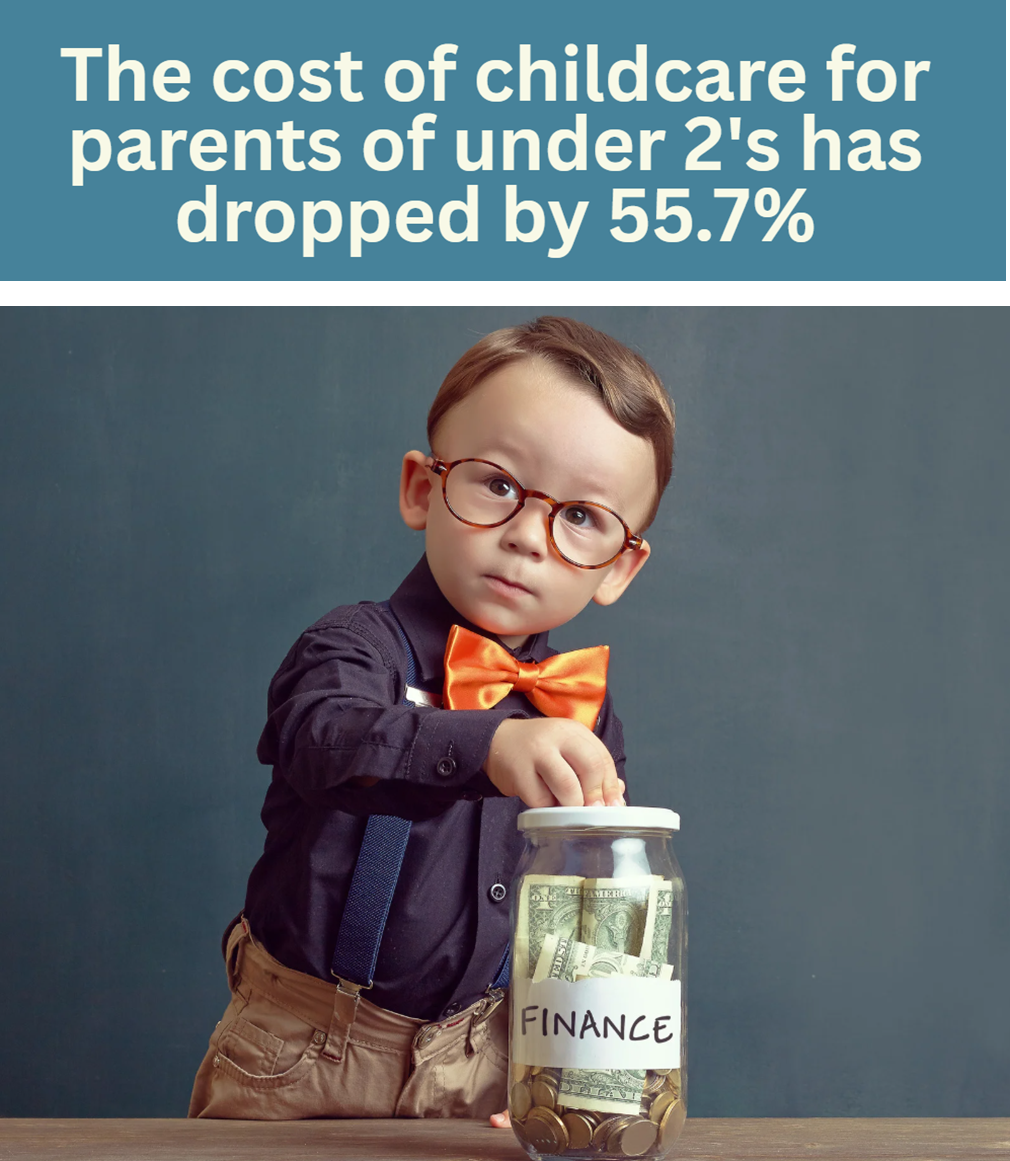
The cost of childcare has seen a substantial decrease for parents of 2s and under over the past year, driven by the introduction of the expanded funded childcare offer. Under the new offer, working parents of children aged 9 months to school age now only pay for additional hours that fall outside their government-funded entitlement and any additional services they require such as meals.
According to the Coram Family and Childcare 2025 Childcare Survey, the average cost nationally of 25 hours of nursery care per week for children under the age of three has dropped by 55.7% compared to 2024. This figure reflects the impact of the expanded entitlements, with parents now typically paying for just 10 hours per week.
Average cost of 25 hours of childcare nationally:
Under 2s
| 2025 | 2024 | Difference |
|---|---|---|
| £70.51 | £159.61 | -55.50% |
2-year-olds
| 2025 | 2024 | Difference |
|---|---|---|
| £66.34 | £153.69 | -56.3% |
The cost is set decrease further in September 2025 when the expansion reaches its final phase of roll-out and eligible parents will be able to access up to 30 hours of funded entitlement, easing the financial burden of nursery fees on parents.
While the expanded funded childcare offer has significantly reduced overall costs for many families, providers have adjusted their rates for additional hours outside the entitlement. This increase is attributed to rising operational costs, including:
- the national living wage
- utility bills
- broader inflationary pressures
Across all provider types and districts within the county, there has been an average increase of 8.11% in the hourly rate for additional hours of childcare.
Average private fees charged across each district area (as an average hourly rate):
| District | Under 2s | 2-year-olds | 3 and 4-year-olds |
|---|---|---|---|
| Boston | £6.75 | £6.37 | £6.11 |
| East Lindsey | £6.04 | £5.93 | £5.67 |
| Lincoln | £5.54 | £5.51 | £5.44 |
| North Kesteven | £5.65 | £5.74 | £5.55 |
| South Holland | £5.75 | £5.72 | £5.51 |
| South Kesteven | £6.22 | £6.03 | £6.13 |
| West Lindsey | £5.75 | £5.69 | £5.52 |
| Lincolnshire average | £5.90 | £5.83 | £5.69 |
Most parents can access government support for paying childcare costs for children aged 0 to 14 years. Government offers are widely promoted to parents and providers in Lincolnshire using the best start for life parent hub. All providers are encouraged to promote this with their parents to ensure their fees remain affordable. Within the provider survey, 98% of providers reported that they promote tax-free childcare to their parents.
Childcare providers are encouraged to promote the tax-free childcare and other offers, which is also promoted with the role of the outreach worker. Lincolnshire offers support and guidance to working and disadvantaged parents and our website has recently been updated with a dedicated section on all the available support with childcare costs.
Early years funding
Lincolnshire saw another uplift to the funded rates in April 2025. Whilst the rising overhead costs for providers and increase in the NLW are a concern, the increase in funding over the past year has gone some way to supporting the sustainability of the sector. In the last 18 months we have also seen the introduction on the funded rate for under 2s which for 98% of the county's providers is well above their private rate.
| Age range | Average provider rate | 2025 EYE funding rates | Difference between funded and private rate |
|---|---|---|---|
| Under 2s | £5.90 | £10.18 | +£4.28 |
| 2-year-olds | £5.83 | £7.41 | +£1.58 |
| 3- and 4-year-olds | £5.69 | £5.21 | -£0.48 |
In addition, to ensure continued access to childcare for families in receipt of additional support, Lincolnshire has introduced a £0.19 deprivation supplement for eligible 2-year-olds within the funding formula.
Providers can access a range of supplementary funding streams in addition to the base rate to support high-quality provision for children from the term after they turn 9 months until school age. These include:
- early years pupil premium (EYPP)
- deprivation supplement
- inclusion funding
- disability access funding (DAF)
Early years pupil premium (EYPP)
EYPP is paid to providers as an hourly supplement of £1 per hour to children who qualify. This supplement aims to improve outcomes for disadvantaged children from 9 months upwards (for 15 hours).
Additional funding to support disadvantaged children
Deprivation supplement is paid to providers to help them support their most disadvantaged cohort of children. The payment is calculated on the previous years autumn term head count and is paid the following financial year over three payments. The amount is worked on individual child's postcodes aligning them to the IDACI scoring. This means providers will receive varying amounts according to the children attending.
Additional funding for children with SEND
SEN inclusion funding (SENIF) is available for children with emerging special educational needs and disabilities (SEND). It is payable to providers at two rates for children that qualify. This is paid for all eligible children in receipt of funded entitlement and is in addition to the normal funded rates for their age.
- inclusion level one - £2.10 per hour
- inclusion level two - £4.20 per hour
Disability access funding (DAF) is also payable to settings for children in receipt of disability living allowance (DLA). This is paid to the provider for all eligible children in receipt of funded entitlement and used to support children’s access to the entitlements. This is currently £938 per year.
| Autumn 2024 | Spring 2025 | Summer 2025 | Total |
|---|---|---|---|
| 86 | 55 | 106 | 247 |
The local authority has seen an increase in provider applications to support children with SEND. We have responded by increasing the amount of funding available to providers through the dedicated schools grant specifically for SENIF. Of those SENIF children accessing provision, attendance shows that the majority are accessing their universal and extended hours.
Supporting business sustainability in early years and childcare
Business sustainability is essential to ensuring the long-term viability of early years and childcare provision. With significant changes to the childcare landscape in recent years, including evolving parental expectations, funding reforms, and shifts in working patterns, it is increasingly important that the market adapts to current trends and remains responsive to local needs.
Our early years and childcare team play a key role in supporting providers to strengthen their business models. A range of support is available to help providers review and develop their business plans, ensuring they are equipped to navigate change and plan for future growth.
Providers across Lincolnshire can access:
- collective support, including:
- workshops
- webinars
- newsletters
- guidance materials
- bespoke support, tailored to individual settings and their unique challenges
- strategic advice on adapting to new parental demand, including:
- extended hours
- flexible models
- inclusive provision
This support encourages providers to take a proactive approach to financial planning, service delivery, and workforce development, helping them to remain resilient and responsive in a changing environment.
By investing in business sustainability, Lincolnshire aims to ensure that high-quality, accessible childcare continues to be available for all families, now and in the future.