Demand for childcare in Lincolnshire
Parents perspectives
As part of the annual childcare sufficiency assessment (CSA), a county-wide survey of parents and carers was conducted in February 2025 to evaluate how effectively local childcare services are meeting the needs of families with children. The survey was widely promoted through a range of channels, including:
- media outlets
- partner organisations
- social media platforms
- Lincolnshire County Council staff
- elected councillors
It received a strong and representative response from parents and carers, providing valuable insights to inform future planning and investment in childcare provision.
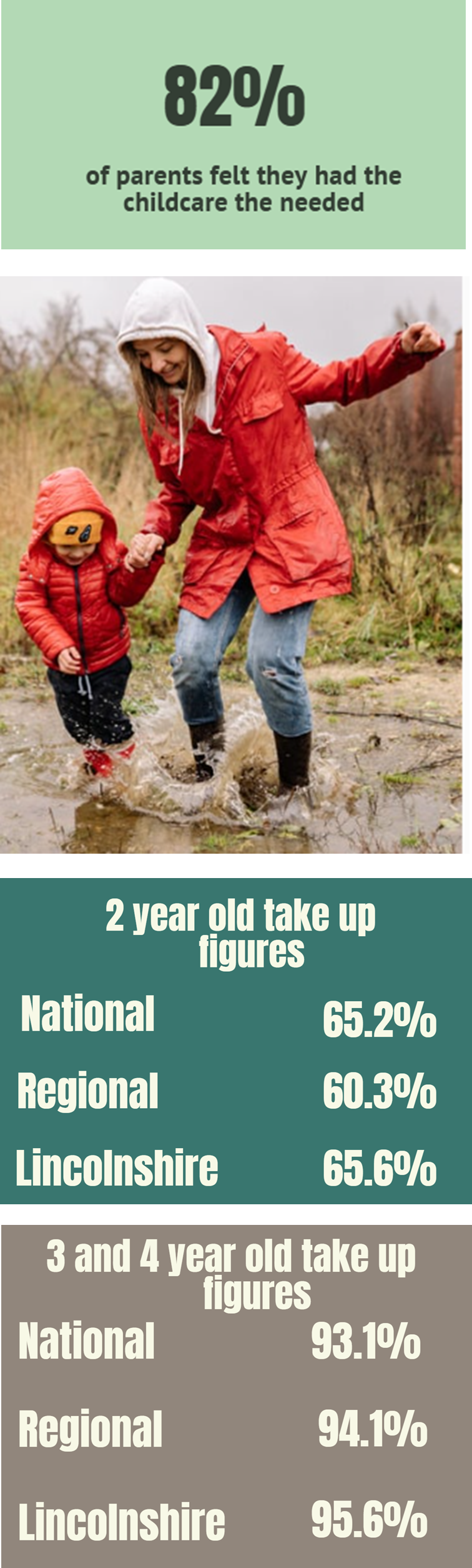
The 2025 childcare sufficiency assessment survey revealed that 82% of families feel their current childcare needs are being met. This is an 18-percentage point increase compared to the previous year. This significant improvement highlights the positive impact of recent investments and growth within Lincolnshire’s childcare sector, demonstrating that the childcare market is effectively responding to local demand and supporting families across the county.
Full details of feedback from the parental survey are included within the engagement report. This information, when combined with our internal data, provides valuable insight into where additional childcare places may be required and informs the strategic childcare development plan for the year ahead.
Take up of childcare entitlements
Lincolnshire currently reports a higher take-up of funded places for 2, 3 and 4-year-olds compared to both regional and national averages.
The demand for childcare is intricately linked to the take-up of available places. While all 3 and 4-year-olds and some 2-year-olds are entitled to at least 15 hours of funded early years education, not all families choose to access this entitlement. Additionally, working parents of children aged 9 months to school age are eligible for up to 30 hours of funded childcare per week. However, take-up of this offer also varies, as not all parents opt to use the full entitlement. These patterns highlight the importance of understanding parental preferences and barriers to access when planning future provision.
Access to high-quality early years education is widely recognised as a key factor in promoting academic success and ensuring children are well-prepared for school. The early years and childcare team in Lincolnshire actively monitors the take-up of funded childcare places. Where low take-up is identified, the service has invested in outreach workers to promote awareness of the funded entitlement across the county. These outreach efforts aim not only to increase participation but also to engage directly with families to understand the reasons behind non-engagement and to address any barriers, ensuring that all eligible children can benefit from early education.
2-year-old take-up
Children aged two may qualify for funded early education under two distinct eligibility categories:
- families in receipt of additional support (FRAS), who are entitled to 15 hours per week of funded childcare. The DWP supply us with details of families who would be eligible. we then monitor the take-up of places by the eligible families
- working families, who are also currently entitled to 15 hours per week, with this entitlement set to expand to 30 hours per week from September 2025. We can see how many eligible codes have been issued by the DfE compared how many have been validated on take up of a place (details below)
FRAS take up:
- national: 65.2%
- regional: 60.3%
- Lincolnshire: 65.6%
Since the childcare reforms and the introduction of the working parent entitlement, local authorities are now seeing an overlap in:
- the families on the DWP list that are eligible for the ‘disadvantaged’ funding
- those who have also accessed a code using the ‘working parent entitlement’
This accounts for the lower take up we are seeing both nationally and locally. By the end of the spring term (following data cleansing, identifying childcare eligible for both entitlements and new children attending) Lincolnshire had over 83% take-up for the ‘disadvantaged’ 2-year-old entitlement.
This strong uptake reflects the county’s proactive approach to promoting early years entitlements and supporting families to access high-quality childcare at the earliest opportunity.
The statistical first release (SFR) is based on data collected during the January census each year. However, it is important to note that take-up of the entitlement typically increases as the academic year progresses. By the end of the spring term, data consistently shows a significant rise in the number of 2, 3 and 4-year-olds accessing places. As such, we can report that take-up at other points in the year is often higher than what is reflected in the SFR.
In Lincolnshire, our outreach processes are being embedded and renewed to identify the children eligible for both entitlements. We are also working alongside colleagues within the performance team to ensure reports can clearly identify and validate those children accessing their entitlement, and cross-matching this data with the online systems delivered by the DfE, HMRC and the DWP.
3 and 4-year-old take up
All 3 and 4-year-olds are entitled to 15 hours of funded childcare per week, with an additional 15 hours available to eligible working families. Universal entitlement take-up is monitored using population data, while the working entitlement is tracked through DfE issued codes and their validation upon placement.
Universal entitlement:
- national: 93.1%
- regional: 94.1%
- Lincolnshire: 95.6%
| Funding | Under 2s | 2-year-olds | 3 and 4-year-olds |
|---|---|---|---|
| Total children accessing | 3,201 | 4,343 | 10,410 |
| Universal entitlement | Not applicable | Not applicable | 10,385 |
| FRAS funding | Not applicable | 1,102 | Not applicable |
| Working entitlement | 3,201 | 3,241 | 5,751 |
Monitoring emerging demand for the working entitlement
The working entitlement for families with children aged 9 months to 2 years is still in its initial stages. We are closely monitoring the take-up of places by working parents to ensure a clear understanding of emerging demand and the additional capacity required to meet it.
A code is issued to parents who qualify for the entitlement and apply online. These codes are validated when families take up their childcare offer. By reviewing this data, we can assess the take-up rate for the working entitlement across the county.
During the spring term 2025, we analysed the number of codes issued compared to those successfully validated. The below information illustrates a high proportion of parents who took up their place, demonstrating that eligible families have been able to access the childcare they need and are entitled to.
Validation rate:
- under 2s: 95%
- 2-year-olds: 97%
- 3 and 4-year-olds: 96.5%
The strong validation rate also suggests that awareness and accessibility of the entitlement are improving. If current trends continue, we anticipate a sustained or even increased uptake in future terms, particularly as outreach efforts and digital application processes become more streamlined. Continued monitoring will be essential to ensure that all eligible families are supported in accessing the childcare provision they need.
While full data will not be available until the final phase of the entitlement expansion in September 2025, we have proactively used existing data on the take-up of the working entitlement for 3 and 4-year-olds. By mapping these percentages (see chart below) against ward-level data, we have been able to model and forecast anticipated demand from September 2025 onwards. This approach supports strategic planning and ensures that future provision is aligned with expected needs.
| District | Percentage of children accessing 3 and 4-year working entitlement |
|---|---|
| Boston | 48% |
| East Lindsey | 50% |
| Lincoln | 45% |
| North Kesteven | 65% |
| South Holland | 48% |
| South Kesteven | 59% |
| West Lindsey | 53% |
| Lincolnshire average | 52% |
Mapping of demand
Since the announcement of the childcare reforms in spring 2023, the Department for Education (DfE) has provided local authorities with supply and demand modelling to support planning for early years expansion. This dataset includes estimates of the known supply of places in Lincolnshire, the potential demand for places for children aged two and under and like our own data, includes a redistribution factor. This factor accounts for the movement of families across the county when accessing childcare, ensuring that provision is not only increased but also strategically aligned with actual patterns of demand
We have used this information to cross-reference the DfE data with our internal datasets to validate what we know. While the datasets are broadly aligned, we have identified notable differences at ward level, which highlight the importance of maintaining locally informed intelligence to ensure accurate sufficiency assessments.
This comparison has strengthened our understanding of where gaps may exist and will inform future decisions around targeted investment and support for providers.
Armed forces covenant
We have signed up to the Armed Forces Covenant, which ensures fair treatment for serving personnel, veterans, and their families. This includes equal access to public services like childcare.
The early years and childcare team works with the MOD to make sure there are enough childcare places for armed forces families living and working in Lincolnshire. Funding is available through the MOD Armed Forces Families Fund: early years programme to support the sufficiency in locations where there is a high proportion of armed forces families are accessing childcare and we will work with providers in order to meet their unique needs.
Lincolnshire sufficiency data
The data collected through our annual survey is analysed using a simple formula that compares the local population with the number of available childcare places in each age group. This generates an expected demand in districts, children’s centre reaches, and ward-level, indicating whether there is a sufficient supply, a surplus, or a deficit of places to meet local demand.
When a deficit is identified within the data, we assess whether it justifies the creation of additional childcare places by considering a range of contextual factors. These include the availability of places in neighbouring wards, the demographics of families within the affected area, local intelligence gathered from childcare providers and parents, and the accessibility of alternative options.
A recorded deficit does not automatically indicate a need for more childcare provision, just as a surplus does not necessarily confirm sufficiency. Rather, these figures serve as a starting point for further investigation and informed decision-making. The local authority data currently shows a small shortfall of places for the 2-year-olds and under 2s, whilst the 3 and 4-year-old places data shows a surplus. This is used to inform further investigative work and is used to consider future development of places.
The data used by the local authority reflects the net shortfall or surplus of childcare places within each district. However, it is important to recognise that each district may contain areas of both oversupply and undersupply. Therefore, a comprehensive assessment must consider all available information around demand to determine whether additional places are genuinely needed. This includes the datasets provided by the DfE which are used to validate local intelligence.
There are some areas within the county where we need to work with the sector to increase the childcare places on offer. The grid below shows the districts within the county where our data indicates there may be a need for additional places.
| Under 2s | 2-year-olds | 3 and 4-year-olds |
|---|---|---|
| Boston East Lindsey West Lindsey South Holland |
Boston East Lindsey Lincoln South Holland |
Boston Lincoln South Holland |
The demand in each district varies and further in-depth data and analysis is supplied upon request to the early years and childcare support team: childcaresufficiency@lincolnshire.gov.uk.