Supply of childcare in Lincolnshire
The childcare market in Lincolnshire
Lincolnshire has a broad range of early years and childcare services that offer parents a choice of provision. At the time of the survey (February 2025) there were 621 early years providers across Lincolnshire, including schools that provide early years childcare.
Full time places available:
- under 2s: 2,535
- 2-year-olds: 4,357
- 3 and 4-year-olds: 9,025
A full-time place is one that is available five days a week for at least 30 hours. These places can be taken by one child or used by multiple children on a part-time basis.
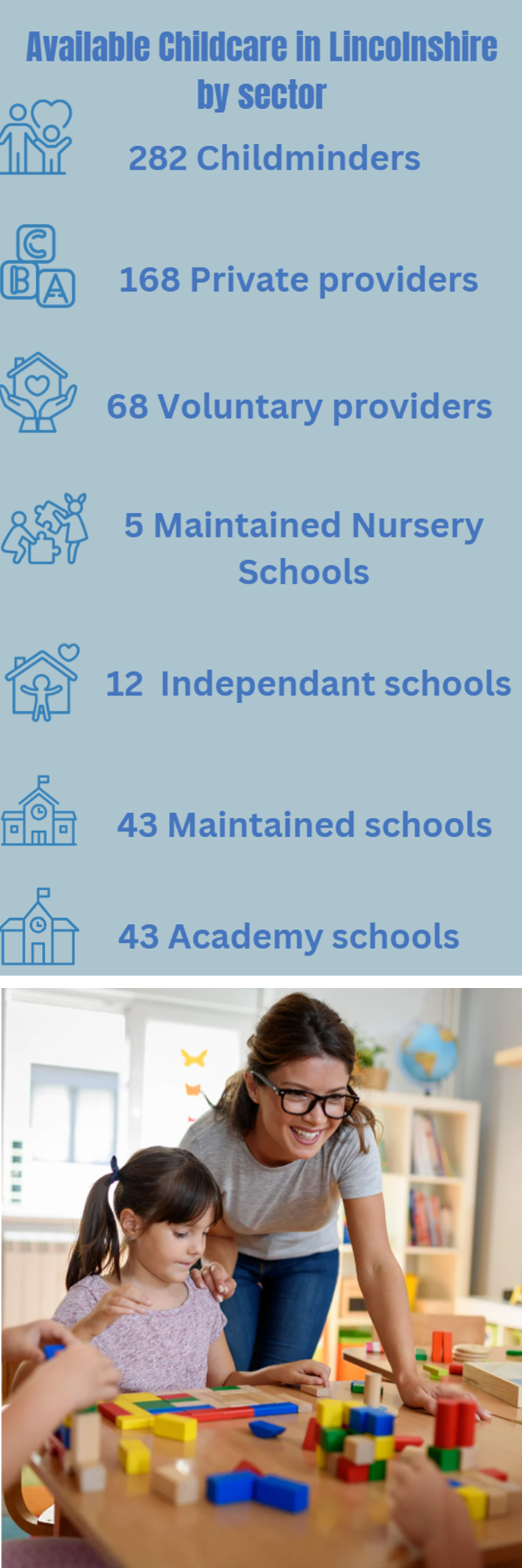
Available childcare in Lincolnshire by sector
- 282 childminders
- 168 private providers
- 68 voluntary providers
- 5 maintained nursery schools
- 12 independent schools
- 43 maintained schools
- 43 academy schools
Childminders represent the largest group of providers. However, due to the number of children they can care for within the EYFS statutory framework, they only deliver a small proportion of places compared to the rest of the private, voluntary and independent sector.
| Provider type | Under 2s | 2-year-olds | 3 and 4-year-olds |
|---|---|---|---|
| Childminders | 13% | 8% | 3% |
| Private, voluntary and independent | 86% | 81% | 71% |
| Schools | 1% | 11% | 26% |
The largest proportion of childcare places are delivered by the private sector, which includes childminders. Our ability to foresee changes and manage the private market can be more challenging. It is therefore essential that we maintain a strong relationship with the sector, ensuring consistent communication and localised intelligence to gather updates on the availability and sustainability of the provision being delivered.
Over the past decade, Lincolnshire has seen a significant change in the delivery of early years education and childcare. There has been a clear shift away from traditional sessional models, typically operating from 9am to 3pm during term time, towards more flexible, full-day and all-year-round provision that better supports the needs of working families.
This evolution has been further accelerated by the introduction of the 30 hours funded childcare entitlement for working parents, which has required many early years settings to extend their operating hours and adapt their delivery models.
As a result:
- A growing number of sessional pre-schools have expanded their hours, offering all day care and more flexible attendance patterns.
- There are now very few settings operating solely under the traditional 9am–3pm model.
- Providers are increasingly aligning their services with the working patterns of parents, contributing to improved access to childcare and supporting parental employment.
This shift reflects a broader commitment across the county to ensure that early years provision is both responsive and sustainable, meeting the changing needs of families and supporting Lincolnshire’s wider economic and social goals.
SEND provision and accessibility
Schools, early years and childcare settings, and other organisations providing services for children are legally required to make reasonable adjustments and deliver high-quality, inclusive provision to ensure that all children have equal access to play and learning opportunities.
This duty is underpinned by a robust legislative framework, including:
- The Equality Act 2010
- The Children and Families Act 2014
- The SEND Code of Practice (2015)
- The Early Years Foundation Stage (EYFS) Framework, which governs early education for children aged 0 to 5
Together, these frameworks ensure that children receive the support they need, when they need it, and that every child can reach their full potential. Under these provisions, all children and families must have access to an inclusive childcare place.
It is our view that the implementation of these frameworks ensures that all early years provision funded in Lincolnshire is inclusive and aligned with statutory expectations. These frameworks provide a consistent foundation for delivering high-quality, accessible early education, ensuring that every child, regardless of background or need, can thrive.
To strengthen this further, over the past two years, we have worked closely with the early years sector and all family-facing professionals, including local authority staff, to strengthen inclusive practice. Through a free online inclusion training programme led by Dingley’s Promise, professionals have had the opportunity to upskill their knowledge and confidence in supporting children with special educational needs and disabilities (SEND).
This initiative has:
- broken down barriers to accessing early years settings and services
- enabled children with SEND to achieve their full potential
- ensured access to highly skilled educators equipped to deliver inclusive, responsive care
This work reflects our ongoing commitment to ensuring that inclusive practice is embedded across all early years provision, and that Lincolnshire remains a place where every child can thrive.
Analysis has been completed to understand the number of children accessing their entitlements with SEND. The chart below provides an overview based on total children in each age range and those with SEND or an EHCP.
Inclusive places being offered and current take-up:
| Type of education | Under 2s | 2-year-olds | 3 and 4-year-olds |
|---|---|---|---|
| No special education | 3,177 | 4,240 | 9,909 |
| SEN | 8 | 87 | 438 |
| EHCP | 5 | 14 | 79 |
| Percentage with SEN or EHCP | 0.4% | 2.32% | 4.96% |
To support those children with SEND or an EHCP, the local authority provides additional funding through:
- DAF
- early years inclusion funding
- high needs funding
This enables children to access the same provision as their peers and supports providers costs associated with their needs.
Expansion of the funded entitlement and growth in childcare places
The ongoing childcare reforms are benefiting working families significantly, reducing costs to parents and making childcare more accessible. Starting April 2024, funded entitlement expanded to include 15 hours for 2-year-olds of working parents. By September 2024, the entitlement expanded to include all children of working parents from 9 months to school age.
From September 2025, eligible parents can access 30 hours of funded childcare weekly for children from the term after they turn 9 months until school age, potentially saving up to £7,500 annually for one child.
The expanded entitlement complements additional assistance for parents through tax-free childcare. The reforms and expansion of the funded childcare entitlement has led to a significant increase in the availability of childcare places across Lincolnshire to meet the rising demand for places for children aged two years and under.
Targeted investment in childcare infrastructure
This growth has been made possible through a dedicated grant programme funded by the Department for Education (DfE) and administered by us. Lincolnshire were allocated £1.46 million capital grant funding to support in securing sufficient places to meet new demands. An open and transparent funding application process was launched in April 2024. Since then, a total of 21 capital and revenue grants, amounting to £0.708 million, has been awarded to local childcare providers. These grants have supported the development and expansion of high-quality childcare provision across the county, enabling providers to create new places and enhance existing facilities to better meet the needs of children and families.
| District | Under 2s | 2-year-olds | 3 and 4-year-olds |
|---|---|---|---|
| Boston | 37 | 38 | 43 |
| East Lindsey | 19 | 28 | 49 |
| Lincoln | 24 | 22 | 24 |
| North Kesteven | 35 | 33 | 44 |
| South Kesteven | 41 | 28 | 20 |
| South Holland | 12 | 2 | 6 |
| West Lindsey | 0 | 0 | 8 |
| Total | 168 | 151 | 194 |
School based nursery grant programme
Phase one of the school based nursery capital grant programme was launched in October 2024. This was the first stage in a long-term commitment by the government to expand school-based nurseries across England.
The funding was for eligible state-funded primary-phase schools to bid for up to £150,000 of capital funding. The funding could only be used for capital expenditure to repurpose spare space within the school building that would create or expand nursery provision.
As part of Lincolnshire’s commitment to expand early years provision, 15 applications were submitted to the Department for Education (DfE). Of these, seven were successful, resulting in the creation of an additional 171 childcare places across the county and a total investment of £772,239 into Lincolnshire childcare.
All new places are expected to be operational during the 2025 to 2026 academic year, further strengthening access to early education for families in Lincolnshire.
| School name | Additional under 2s full time places | Additional 2-year-olds full time places | Additional 3 and 4-year-olds full-time places |
|---|---|---|---|
| Friskney All Saints Church of England Primary School | 6 | 15 | 0 |
| Malcolm Sargent Primary School (Acorn Childcare Centre) | 12 | 6 | 0 |
| The Donington Cowley Endowed Primary School | 0 | 0 | 16 |
| The Gainsborough Hillcrest Early Years Academy | 15 | 5 | 13 |
| The Lincoln Manor Leas Infants School | 0 | 0 | 28 |
| William Alvey School | 0 | 0 | 26 |
| Wygate Park Academy | 0 | 0 | 29 |
| Total | 33 | 26 | 112 |
The Department for Education (DfE) has officially launched phase 2 and announced phase 3 of its school-based nursery programme, reinforcing its commitment to expanding early years provision across England.
We have received strong interest from schools across Lincolnshire in expanding nursery provision, reflecting a clear appetite within the sector to support early years developments and meet growing local demand. Based on this engagement and the county’s proactive approach to early years planning, we are confident that Lincolnshire will be well-positioned to secure further funding in phase 2 and 3.
Childcare expansion grant
The DfE announced the early years expansion grant, which will provide an additional £75 million of funding to support the sector as it prepares to deliver the final phase of expansion of the working parent entitlement from September 2025.
Lincolnshire’s allocation was £927,727 and the local authority used the approach to distribute the total allocation between providers as a flat rate per-part time equivalent, according to the number of 2-year-olds and under 2s taking up the early education entitlements in settings.
Ongoing developments
We continue to work proactively with the early years and childcare sector to develop new places in areas where demand demonstrates a clear need. This targeted approach ensures that resources are directed where they will have the greatest impact on supporting families and enabling parental employment.
South Holland remains a priority due to an identified gap in provision. However, progress in this locality has been challenging, primarily due to competing demands for available infrastructure from other industries operating in the area. These pressures have limited the availability of suitable premises for childcare expansion.
Despite these challenges, there is continued interest from the sector to expand provision, including from providers based outside of Lincolnshire. Currently, three active projects are underway, reflecting a strong commitment to meeting local needs.
Looking ahead, the priority for any remaining funding will be to support the development of places for children aged two and under, particularly in areas where gaps in provision have been clearly identified.
We remain committed to working collaboratively with local partners, providers, and stakeholders to explore innovative solutions and unlock opportunities for sustainable childcare growth, not only in South Holland but across all areas of unmet need in the county.
Further knowledge of demand is anticipated following the implementation of the 30 hours from September 2025.
Workforce challenges and undelivered capacity in childcare provision
As part of our recent provider survey, we asked early years and childcare settings about undelivered capacity, places they are registered to offer but are currently unable to deliver. A total of 57 providers reported having childcare places they could not offer, citing a range of reasons. However, the most frequently reported barrier was the inability to recruit suitable staff.
This local insight reflects a wider national concern around recruitment and retention in the childcare sector. Many professionals are leaving the field in favour of better-paid roles with fewer responsibilities, which is contributing to staffing shortages and, in turn, limiting the availability of childcare places across Lincolnshire.
Reasons for undelivered capacity (amount of respondents)
- unable to recruit staff - 27 (47%)
- other - 17 (30%)
- no parental demand - 9 (16%)
- undeveloped space or rooms - 3 (5%)
- issues with building - 1 (2%)
Unable to recruit new staff is a prevalent reason for undelivered capacity, therefore, supporting the recruitment and retention of the early years workforce is a key priority for Lincolnshire early years and childcare team. We are working in partnership with a range of external agencies, including schools, the Department for Work and Pensions (DWP), and career advisors; to promote childcare as a rewarding and sustainable career.
In 2024, the government launched the Do Something Big campaign to attract new entrants into the sector. We have actively supported this initiative by promoting it widely through our communication channels.
In addition:
- we have strengthened relationships with local colleges to support the transition of students from training into employment
- our ongoing collaboration with the DWP ensures that frontline staff working with jobseekers are well-informed and continue to highlight childcare as a viable career option
- a targeted campaign plan is in place to further enhance recruitment efforts, including a focus on increasing the number of registered childminders across the county
- these efforts are part of a broader strategy to build a resilient, skilled, and motivated workforce capable of meeting the growing demand for high-quality early years provision